Friday, 16 August 2013

A smutty month with good days up on high

It’s catching!  Sitting at the microscope one afternoon Janet appeared at the door and said “is this of interest”, holding a big, floppy melancholy thistle leaf, covered in parts by fungus spots.  Amazingly, I scraped a bit of the fungus off and within a few minutes was able to tell her that she had found a fungus with the amazing name of Puccinia cnici-oleracei.  Not content with that there next appeared a leaf from the garden berberis with a similar set of orange spots which turned out to be Puccinia graminis, a rust fungus more often found on cereal crops and with so few records from other species, the fungal department at Kew were happy to have the specimen for their collection.  As you will have gathered Puccinia rusts seem to be
Puccinia cnici-oleracei on melancholy thistle leaf
quite common and when you realise that there are about 250 species known in Britain, there are plenty more to find, one of which will feature a little later in this diary.  As with birds and plants this is the re-productive season for these amazing organisms each awaiting the annual appearance of their specific plant host before beginning their own re-productive cycle.  This is quite handy when trying to identify the particular fungus in that many identification guides list the host plant and the species of fungi you might find on them.  One major acquisition in this line has been ‘Microfungi on Land Plants by Ellis and Ellis’, and in the 860 pages there are a few thousand species listed, all linked to the plants they grow on.  No pictures, but a few line drawings and good descriptions but in a scientific language that takes a bit of getting used to.  Bird watching seems quite simple by comparison but even here you need a type of magnifying glass to carry out your hobby.

The major event of July was helping with local logistics for a visit organised by the locally BSBI Recorder for Moray, Ian Green, and the Wildflower Society.  Outings were planned for Loch an Eilein and Glen Feshie, and following a few phone calls the Conservation Manager for Glen Feshie Estate gave permission to take a limited number of cars into the glen, saving many miles of walking to and from the recording area.  Under a blazing sun and in temperatures in the high twenties, this proved to be most welcome.  The Saturday
Small argent and sable
afternoon to Loch an Eilein was a short outing around the loch, to introduce the Society members from the south of England to species common in the north but rare in the south, and to generally get to know one another.  Lesser twayblade, creeping lady’s tresses and water lobelia were all nice finds as a precursor to the full day out the following day in Glen Feshie.  The Sunday outing was aimed at recording as many plant species as possible combined with an official Site Condition Monitoring visit for a very rare fern, Oblong Woodsia (Woodsia ilvensis), the Feshie site being one of just a handful in Scotland.  After meeting up at Uath Lochans to decant into fewer cars, we made our way up the glen to just beyond the Lodge, and as we prepared for the walk ahead I noticed small, day-flying moths buzzing about the roadside verges, being
Wood vetch
identified later from photos as the small argent and sable.  A new site and quite a way from its nearest neighbour – a good start.  A visit to river gravels where the track ran close to the river produced the brilliantly named tea-leaved willow (Salix phylicifolia) plus a hybrid which was heavily debated and requiring a specimen to be sent of to the UK authority on willows.  Starry and yellow saxifrage were also found on the shingles.  Much further up the glen the group stared in disbelief at a huge patch of white flowers covering a boulder filled gully – wood vetch, a plant which is normally found in small quantities.  The vetch

Glen Feshie outing
indicated lime richness and a visit to the lower boulders found a few plants of limestone bedstraw (Galium sterneri), along with lesser twayblade and the first spikes of mountain sorrel (Oxyria digyna).  Oak and beech ferns were also found in their brilliant fresh, green colour.  The next mini-adventure was crossing the River Feshie before having lunch and for most, this involved removing boots and socks.  A quick check of the riverside rocks produced a single 5-spot ladybird (Coccinella quinquepunctata) but a search of the
Woodsia ilvensis
river gravels failed to find any of the Peltigera lichens often found in that habitat.  With lunch over it was time to head in the direction of the Woodsia site but on the way a search was made for an old record of twinflower in an area of oldish Scots pine.  The estate owners have been following the objective of trying to regenerate the woodlands naturally by deer control and as we walked we could see they were having great success with young birches and pines popping up everywhere.  This management though does mean that the woodland floor vegetation was a little longer than the norm and we had to search a little harder for the as yet, unopened flowers of twinflower, in amongst blaeberry and grasses.  Would the Oblong Woodsia be just as difficult to find?  There was a bit of debate about which scree to check, but eventually by using the “Goto” facility on my GPS we headed in the right direction.  To aid the Site Condition Monitoring, Ian had been given a series of photos of the Woodia fronds from past monitoring visits, and eventually the right rock was
Procumbent pearlwort posed a problem
found – yes, one small rock, around which the fern was growing.  Well done the person who first found the plant, not an easy job on a mobile scree slope.  Fronds counted, photos taken, it was time to head back down river towards the cars.  A pearlwort on an area of extensive river gravels (these alone would be worth a major survey) had everyone scratching their heads and eventually a sample was taken to send off to the UK expert.  The name that came back was, procumbent pearlwort (Sagina procumbens), a fairly common species but the one debated had rather unusual petals but not the right number of stamens.  Back at the place where the cars were parked there was just one last hurdle to complete – getting back across the river.  The
Contarinia loti gall on bird's-foot trefoil
bridge that used to be at this location was destroyed in a recent winter flood and the estate has decided not to replace it.  As folk removed boots and socks once again, a few of us wandered back and forth looking for anything unusual on the river gravels.  A tiny patch of purple saxifrage was the only record for the day of this plant, washed down from its normal rocky habitat and a patch of bird’s-foot trefoil was looking rather odd with bulbous growths instead of flowers, a plant gall which turned out to be Contarinia loti, complete with four larvae per gall when checked.  This was almost a new record for Scotland according to NBN, with just one record along the Caithness coast!  Goodness knows what else there is to find in this amazing glen.

Ian and the Wildflower team were heading up into Coire Garbhlach (a side glen to Glen Feshie) the next day, a visit I couldn’t make, to do some recording of montane flowers, but Ian kindly sent me a list of what they saw.  I have visited this glen on two previous occasions to look for one of our other rare ferns, mountain bladder-fern (Cystopteris montana), but without success.  This fern was originally found by one of the best
Anthracoidea paniceae smut fungus on Carex panicea
UK Ecologists Dr. Derek Ratcliffe, whose diligence produced many unusual records.  I watched the weather forecasts and once I saw a day where the sun would be tamed a little by cloud, I decided this would be the day I would once again try and get back to those impressive cliffs towards the top end of Coire Garbhlach.  With the car parked at Aclean the initial walk is on the level parallel to the River Feshie but as the cliffs at the t
Alpine cat's-tail - Phleum aplinum an alpine grass
op of the glen start to appear, then the climbing begins.  I decided to follow the Allt Garbhlach because of the variety of plants and other species that would grow there compared to the heathery hillsides either side.  The first find was one of the Anthracoidea smut fungi growing on carnation sedge (Carex panacea) and then, on the river gravel the lichen Peltigera leucophlebia.  Ian had left a query following his visit about the true identity of one of the alpine grasses, and, with a good reference as to its location, I managed to re-find it just beyond the top of a very impressive waterfall.  Again, this was a species which had probably been washed down from higher up and when I saw it I recognised it as alpine cat’s-tail (Phleum alpinum) from
Towering cliffs upper Coire Garbhlach
past forays onto the high tops.  With double spiky awns protruding from the flower head it is quite an easy grass to remember, but why just one plant on its own?  A little further on and the towering cliffs were coming into view, how good it was for the body to be behaving itself and to be visiting once again, the natural alpine “gardens” of our mountains.  On the way up the scree below the cliffs was a single clump of mountain male fern (Dryopteris oreades) and on the damper rocks starry saxifrage and moss campion (Silene acaulis).  I knew I was close to achieving a long-held ambition to see one of the UK’s rarest fern and after a bit of
Mountain bladder fern - Cystopteris montana at last!
scrambling around (sorry Janet!) I was within touching distance of the mountain bladder-fern.  It’s not easy taking photos in a windy gully whilst holding on with one hand and finding good footholds to stand upright,
but who cares, my mission had been achieved.  The worst bit about getting to these loft heights (well 800m) is that there is a great reluctance to go back down, so I found a comfy spot for a bit of lunch whilst checking what was on the rocks beside me.  I had seen wholly willow close to the fern, but by my lunch spot was another mountain one, whortled-leaf willow (Salix myrsinites) and on some leaves there were even plant
Puccinia septentrionalis on alpine meadow rue
galls belonging to Eupontania myrsiniticola a wee sawfly whose distribution is restricted to Scotland.  Just to my side I could see what looked like an orchid and sure enough there were several flowering spikes of frog orchid which I was quite surprised to see so high up.  Lunch lasted about five minutes as I was keen to see what else was on the rocky slopes and a familiar lichen found earlier in the day, P. leucophlebia, was found along with the wispy flower spikes of alpine meadow-rue (Thalictrum alpinum) but with some very strangely coloured stems and leaves – more Puccinia rust fungus, but on a mountain so could be a good
Moonwort
find.  Once home it was easily identified (by host and colours) as P. septentrionalis providing just the fifth dot for the NBN UK map.  All good things come to an end and by mid-afternoon I was on my way back down, but with the advantage of height, I was able to see a fairly distinct deer track, quite a way above the Allt Garbhlach, which looked like the right route to aim for.  Interestingly, Ian and the botanists must have done the same thing as quite a way down the track we both found the same patch of the fern moonwort (Botrychium lunaria) growing alongside a still flowering patch of mountain everlasting (Antennaria dioica)!  What a brilliant day.

Earlier in the year, a friend, Sandy, had asked if I would like to be part of an experiment he was considering involving the green shield-moss (Buxbaumia viridis).  The experiment would involve trying to collect spores from the mature moss capsules and, after mixing with water, try inoculating suitable logs with the spores to see if it was possible help the population by introducing spores to new sites.  Having seen so many capsules over the last few years I had been wondering how easily the moss can move around naturally, as capsules suddenly appear in areas (as far as seen by humans) well away from known sites.  To undertake the work it would be necessary to have logs or substrates with capsules outside designated conservation areas to save having the hassle of the red-tape hoops that would have to be jumped through, though a licence would be needed from SNH for the work to allow us to “interfere” with the mature capsules in, as yet, an undecided
Collecting green shield-moss spores
way of how to actually collect the spores.  The moss remains on
Schedule 8 of the Wildlife and Countryside Act 1981 meaning that the moss is “protected from intentional picking, uprooting or destruction” so the work would need to be none-destructive, leaving the mature capsules in place before and after spore collection.  A couple of years ago I photographed spores being ejected from a capsule of the brown shield-moss and it was hoped that by using water, we might be able to “encourage” the capsules to eject spores, for us to collect, whilst leaving the plant in place.  So, midway through July I received a phone call to say a site had been chosen where there were plenty of this year’s mature capsules and that an evening meeting had been arranged to trial spore collecting techniques.  There would be four “enthusiasts” including SNH’s bryophytes, fungi and lichens expert, and the site was a community woodland near Beauly.  At the first log the debate
Green shield-moss spores in vial
started about how best to tempt spores to eject and whilst Dave was applying a second drop of water to one of the capsules via a pipette he noticed something discharge from the capsule.  He then did it again.  I produced some small vials from my rucksack which were smaller than those others had brought and by carefully holding the vial close to the spout of the capsule and touching the capsule with the pipette, bingo, a green splodge of spores was ejected into the vial.  This was repeated at several other capsules with varying degrees of success, but most capsules produced something and certainly enough to continue to the next step of the experiment.  Initially I tried to capture an ejection on camera but failed miserably, but then I remembered my wee camera also had video capability and so, by carefully setting the camera on its gorillapod and focusing continually on the spout of the capsule, an ejection was captured for the first time (as far as I know) on video.  See Link below.  I had just one log with capsules outside any reserve designated
Buxbaumia viridis (green shield-moss) spores
lands and a day later I visited it and, after a long wait to allow the very dry capsules to re-hydrate, spores were obtained ready for the next step.  My inoculation site comprised Norway spruce logs and root buttresses and over an hour the spores were introduced to the potential growing sites via a small pipette, carefully marking each location, along with a non-inoculated control site close by, with white cocktail sticks.  We all await with interest to see if anything starts to grow in late September.  In all the years of working with the green shield-moss I have never actually looked at any spores and, with a small amount of spore mass left I popped a bit under the microscope to see for the first time, what actually make the moss “tick”.

The pine martens have continued to entertain, though with few contacts at the time of writing.  Perhaps the most amazing encounter was on the 1st July when we watched a single animal wander from the squirrel feeders, through the garden to feed on a couple of apples which we had put out for blackbirds by the decking in front of the French windows, which, thankfully, were open.  Janet shouted “it’s on the deck!” just
Pine marten on deck
at the time I had been trying to put a bit of food on a plate to throw out with the apples.  The camera had already been in operation and was lying on the table so very slowly I ventured to the French windows and placed the dish of food on the deck with the pine marten watching a short distance away to my right.  Blow me if it didn’t run away but came to see if there was anything of interest on the plate.  It didn’t try any of the food but did give me a chance to record our close encounter of the “marten” type.  Towards the end of the month Laura was over to visit Ruth, Lewis and the boys and had never seen our pine martens, so I was
Wow!
keeping a bit of an eye open for any activity.  Returning from putting something in the recycling bin in the outside shed I could hear a pine marten in the big pine behind the garage, so I quickly nipped in to tell Laura to grab her camera and follow me with mine, back outside.  We then realised that there wasn’t one, but two martens in the pine and it was probably the presence of Pipsy our cat that was keeping them there.  Eventually the cat returned to the house and the martens headed back towards the squirrel feeders, not two but three of them!  Daylight was fading but there was just about enough light to capture what had to be mum and two youngsters all fighting over who could have which feeder.  Perhaps we need three feeders!

Not content with ascending to 800 metres I was tempted to go looking for a few plants up at around the 1000 metre mark in Coire an t-Sneachea, one of the Northern Coires of Cairn Gorm.  A few chalet visitors have asked, in recent years, about some of the rarer plants that I had seen previously in this area, and after saying that they might be found in this general area, I thought it best to see if it was still possible to see them. 
Salix herbacea and Eupontania herbaceae gall
Alpine saxifrage and Highland saxifrage are two regularly asked for so, with these in mind out came the Leki poles and off we headed for the boulder-field below the crags.  Because of the number of climbers and walkers using this route the path several years ago was quite a mess, particularly in areas close to the wee burn, but, with path repairs that have been carried out in the last couple of decades there is a good path almost all the way to the famous boulder-field.  So, at a gentle plod, I made my way from the car park and up the hill, being passed a couple of times by rope bearing folk, pretty desperate to get to the cliffs to get climbing.  As height was gained, the vegetation became a little sparser and I could see patches of dwarf willow (Salix herbacea) in amongst the rocks by the path.  In need of a decent photo I stopped to seek out one of the better patches and again realised that some leaves were carrying plant galls.  Photos were taken
The Goat Track in Coire an t-Sneachea
along with a leaf specimen for checking once home.  I knew I had seen both saxifrages on either the base of the cliffs or on the damp rocks by the side of what is known as the Goat Track, a narrow track traversing the less steep sections of rock, eventually giving access to the plateau.  Along the damper sections at the base of the rock face the going was quite difficult due to steepness and rock fans from the gully’s above, and it was hard work getting close to what looked like the better bits of rock.  Starry saxifrage was everywhere and the showy white flowers of northern rock-cress.  A common sedge in these sorts of areas is stiff sedge (Carex bigelowii) and whilst trying to find sheathing sedge (Carex vaginata) I noticed that the fruits on some of the stiff sedges were covered in a smut fungus, black balls with a white outer skin.  Hmm, another interesting
Smut fungus (Anthracoidea bigelowii) on Carex bigelowii
find, and an unusual group of fungi that I had been keeping an eye open for with one of the species mentioned in last months diary.  A couple were collected for homework (identified later as Anthracoidea bigelowii).  A patch of globeflowers took me by surprise and though there is a record for the plant nearby, this site appears to be new.  I traversed across to the Goat Track and started to make my way up, keeping a careful eye on any damp rocks by the side of the track.  Somewhere along the upper section of this track, many years ago, I found the Highland saxifrage, but as I climbed higher there were quite a few “new” tracks leaving what I assumed was the old main track,
Students from Glenmore Lodge
and that I wasn’t at all sure where, exactly, the plant had been.  Despite quite a bit of wandering about I failed to find any flowers, perhaps I was a bit early.  I had seen the flower further round the Coire close to an obvious bright green flush on the hillside, so I slowly made my way there, checking all suitable sites as I wandered.  I stopped for a bite to eat and noticed more of the rust on alpine meadow-rue but also what looked like more spots of a rust on the leaves of a patch of starry saxifrage – more homework.  Another of those pesky Puccinia’s – P. saxifragae.  I was also becoming aware of voices nearby and eventually a
Puccinia saxifragae on starry saxifrage leaves
group of trainees from Glenmore Lodge and their leader popped up from below, said hello and made their way over towards the Goat Track!  Two adult snow bunting came close to me whilst having lunch, both collecting food to feed a family somewhere nearby.  Despite spending about an hour in the area of the green flush neither of the saxifrages was found, so time to make my way back down to the car having had another enjoyable day in amongst the alpine plants.

An evening cutting back rhododendron close to the one-flowered wintergreens near Grantown had a bonus.  Checking out a few of the wintergreens after the pleasures of rhodo bashing, a few leaves on a patch of blaeberry looked a bit odd so I took some back to check.  A bit more was found whilst visiting one of the
Exobasidium arescens on blaeberry (Vaccinium myrtillus) leaves 
twinflower sites to re-photo the rare Septoria fungus (see earlier diary) to see whether it was still identifiable so late into summer.  I made a stab at it being Exobasidium arescens, another leaf fungus, and after a request was made to send some to Kew for checking, confirmation came back that I was correct, a second site for Scotland and the fifth in the UK and the first record for 10 years.  Thanks rhodo, a perfect end to my evenings work.  I also visited a few of my favourite bogs to check sedges and small cranberry (Vaccinium microcarpum) patches for things growing on them.  Many of the cranberry sites had good crops of berries
The beautiful Small Cranberry flowers
which should keep the birds happy, and some patches were still heavy in flower – one of the most intriguing flowers you are likely to encounter whilst out botanising.  The visits were just about perfect for seeing lots of raft spiders (Dolomedes fimbriatus) with their nursery webs plus several spiders which look like raft spiders, but only about half of the size.  Possibly these are youngsters from last summer so one for the spider expert to check next time we meet.  A very late family of blackbirds arrived in the garden on 28th and for the
Raft spider Dolomedes fimbriatus
first time we had adult yellowhammers with youngsters in the garden, an indication that they must have bred quite close by.  And finally, hasn’t it been hot?  Our weather station thermometer topped 30 degrees C for two days running, almost making it too hot for butterfly activity on the transects.  As the temperatures dropped towards the end of the month the first Scotch argus butterflies were encountered, it will be interesting to see if numbers reach the same dizzy heights as last year.  Watch this space.

Enjoy the read.
Stewart and Janet

Wildflower Society

Highland Biological Recording Group website

Dr. Derek Ratcliffe – outstanding ecologist and conservationist

The first filmed footage of the green shield-moss (Buxbaumia viridis) ejecting spores

Tick bites, an occupational hazard

Sundew plant with captured common blue damselfly - quite a meal
The brilliant Glen Feshie

Photos © Stewart Taylor

Thursday, 1 August 2013

Harry arrives just ahead of record count

My brain isn’t very good with Latin, it’s embarrassing at the start of my talks to admit that I will struggle with scientific names of plants and animals covered during my presentation.  Thankfully, most have common names so it is quite handy to be able to add the scientific name somewhere in the Powerpoint slide.  But getting my tongue around leucophlebia (as in Peltigera) or Sphaerulina (as in S. leightonii) sends the brain into panic mode and some word, new to science, usually flows from my mouth.  A couple of months ago though Janet and I learnt a new bit of Latin – Placenta Previa, and though the words are relatively easy to pronounce, they had us very worried.  They relate to a development during pregnancy, and when daughter Ruth told us this had happened towards the end of her pregnancy, we knew that she was entering dangerous territory.  As the baby develops, the placenta provides blood and nutrients via the umbilical cord which is usually located near the top of the uterus.  In this case, the placenta is low down and blocking the birth route for the baby and any bleeding before the end of pregnancy could have quite serious implications for both 

baby and mother.  With less than a month to go Ruth was told she must give up her job and rest as much as possible, and, because when she was at home she was a long way away from Raigmore Hospital in Inverness, we all thought it safer that she spend her day-time hours with us in Nethybridge.  Because of this condition the baby has to be born by caesarean section and so the hospital set a date that we would all be aiming to reach without any mishaps.  Worryingly, we were also told that local doctors and ambulance crews had been alerted as to her condition.  So Lewis, Ruth’s partner would deliver Finlay and Archie to school and playgroup on his way to work and we would run Ruth over to Firwood before picking up the boys allowing Ruth as much rest as possible.  We even managed a bit of pond-dipping whilst Ruth relaxed (above).  And it worked: at 6.45am on 21 June we arrived at Ruth’s and after a group hug Lewis and Ruth headed off to Raigmore Hospital for an 8am appointment whilst I delivered the boys to school and playgroup. 

The long awaited phone call came at about 1pm to say that Finlay and Archie had a baby brother (Harry) who was doing well but Ruth had had a three hour operation following the c-section because of complications.  Only after the baby was delivered did the delivery team realise that Ruth actually had Placenta Accreta where most, if not all the placenta is embedded in the wall of the uterus – a life threatening 

condition due to massive blood loss immediately following the birth.  The atmosphere in the delivery room went from happy chatting to deadly serious as more doctors were rushed in to cover the emergency.  Three hours and four litres of transfused blood later and Ruth was moved to the high dependency ward where eventually she was able to see wee Harry. It was a further two days before brothers and grandparents were able to meet up with the new parents.  For the next few days the boys were at school and playgroup before they broke up for the summer holidays and a couple of days after that Ruth was allowed home from hospital to start what looked like a long recovery.

Driving back and forth to Insh I was noticed lots of flowering spikes of lesser butterfly orchids (LBO’s) making themselves obvious in the Flowerfield Meadow by the B970.  Just in passing there seemed to be many more than in previous years and a quick phone call to Andy the Cairngorms National Park’s Rare Plants Officer allowed a date to be set for their annual count.  Also, looking into the field from the fence by 
Lesser butterfly orchids
the road there seemed to be many more small white orchids, the spikes of which I would count once the LBO’s had been surveyed.  In between times I had been putting the finishing touches to a talk I was due to give in  Boat of Garten village hall and, after putting the boys to bed one night I thought it best to do a timed run of the talk so I knew everything would fit within the time allowed.  Try as I would I couldn’t get through it as the eye-lids kept closing after every five or so slides – I would just have to hope it would be alright on the (following) night.  The next day the orchid count started and with marker canes and tapes the walks back and forth across the field began.  By lunchtime the count was already higher than the previous best and with 
Small white orchids
a bit of a push at the end of the afternoon the whole site had almost been counted.  Andy would return the following day to check the areas just outwith the main count area and I would do the same to count the small whites.  The display this year was so stunning that folk in the know and passing visitors regularly stopped to look over the roadside fence.  A late afternoon visitor was Flowerfield neighbour, David Hayes (of Landmark fame), who, like myself and Andy kept stopping just to take in the amazing display and take yet another set of photographs.  David, like the field’s owners, has watched over the field during the last three decades and neither could remember anything quite like this years display. When asked about the small white orchids we were all in agreement that ten or fifteen years ago there were probably less than a dozen flower spike, this year I counted 1500!  At the end of the afternoon all the counts of the various LBO sections were totalled and came to an incredible 4345 flowers – no wonder folk were stopping to admire.  Amazing!  Over
Common twayblades
the next couple of days the two LBO fields in Tulloch were counted (25 flower spike in each) and I took neighbours Bill and Rita to see the Flowerfield display.  Laura also came over to visit Ruth and Lewis, Harry and the boys and late in the evening we nipped along to see the orchids which, amazingly, were perfectly back-lit by the setting sun.  On the way back to Firwood we also popped in to see how the common twayblades were faring at the Nethybridge gun club site so, if present, they could be marked to avoid trampling.  Once again there were just two young flower spikes developing and a wee cane with red and white tape was installed to try and protect.

As the orchid count finished I had an appointment to see my doctor and for the fourth time I was given a course of pills for the dreaded Lyme Disease.  A bite, high up on my right arm had started to develop the red ring and though not 100% certain that I was infected (blood test not conclusive after a couple of bouts) it

was thought best that I took the two pills a day for fourteen days.  Thankfully I don’t seem to suffer side effects from the pills, so I was happy to take them just in case.  Early on in the month I was quick enough with the camera to get a photo of synchronised feeding by two red squirrels at the box feeders, little did I know what would be next in the synchronised feeding line.  Regular visits from our pine marten continued into June and alarm calling from the garden birds early one morning alerted me to the possibility of a marten at the feeders and sure enough, as I peeked out from the bedroom window an adult and one youngster were each at a feeder.  Camera assembled, wellies on and a pyjama clad Taylor manoeuvred himself carefully into the trellis archway leading to the chalet and, despite lots of interaction between the two martens, both eventually returned to the feeders, allowing for a repeat of the squirrel photo taken a few days earlier.  I had the feeling that there might have been another young(?) pine marten nearby but best not to be greedy and I settled for photos of the two.

Two bird surveys were completed this month but with little luck with the weather.  The weather folk said the evening was to be dry, and for the most-part it was, but for the hour of the last woodcock count there was light rain.  Apart from trying to keep dry whilst looking upwards, the woodcocks still performed their roding flights, but with the cloud, darkness descended early and late evening bird song was almost none existent.  As I made my way back to the car, of course, the rain stopped.  Next day the data was forwarded to the BTO and the end of season report is now awaited.  The 9th June turned out to be a brilliantly sunny day but at 5am it was misty.  Would it be misty higher up where I was to do the Breeding Bird Survey, yes it was.
The usual birds were heard and being a mainly managed grouse moor, once the first 200m of woodland had been left behind, the main birds continued to be meadow pipits, a single red grouse and a distant golden plover.  The cloudberries though were in full flower and only found on the higher sections of the transect, but always worth stopping for a photo.  Blaeberry was also in full flower but the cool, misty conditions meant that there were few bees to record apart from a few hardy blaeberry bumblebees (Bombus monticola).  Later in the day, with the sun going full belt, it was hot enough to go in search of the tiny Osmia uncinata bee, though just one was seen.  Perhaps the most unusual record for June was 21 whooper swans flying over on the 8th, quite a late record, the birds possibly having been held up with cool weather further south during May?  I also managed a short interview for the Out of Doors programme on Radio Scotland.  I had met Mark Stevens in May when he did a programme about the 10th anniversary of the Cairngorms National Park, Tourist Board and Housing Authority (only joking but on second thoughts not really).  I managed one sentence on that programme after a half-hour interview and I suggested to the producer that
Sclerophora pallida pin-head lichen
Mark hadn’t really touched on the important “wee things” that make the Park internationally important, so this visit/interview was to try and rectify that – though we only had one hour!  I thought a visit to Tulloch would meet the brief and allow me to show him the two rare mosses, green and brown shield-moss growing close together but they didn’t make it and the programme clip featured a few of the rarer aspen lichens particularly the tiny Sclerophora pallida pin-head which initially he had great trouble seeing.  I think he failed to appreciate that what he saw in the short time he was out with me, would be quite difficult to replicate in such a small area and in such a short period of time elsewhere within the Park.  Slowly forward.

As we counted the Flowerfield orchids something unusual came into view.  The meadow is brilliant for many plants, not just the orchids and at this time of year (though now probably affected by the summer drought) blue scabious flowers and the “spiky” field gentian take over from the orchids.  As I was walking back and forth I noticed quite a lot of spikes of spring sedge (Carex caryophyllea), a plant that appeared in the last diary.  Nothing unusual in seeing the sedge but I then noticed several of them had large, black balls attached to the “flower” heads –
Anthracoidea caryophylleae and spring sedge
parasitic fungal smuts which I found out belonged to the order Ustilaginales.  These fungi develop as small, thick walled “balls” which typically grow over some of the seeds on the infected plant and on maturity develop into a black, smutty mass in amongst the other seeds on the flower head.  Once seen it’s amazing how many you find as you walk, and from one patch I collected several infected sedges for further investigation.  Once home some of the black, smutty mass was scraped from the seeds and the spores checked under the microscope; the Internet providing an initial name of Anthracoidea caryophylleae. 
Anthracoidea caryophylleae spores - thick walled in places
However, this is a complex group of fungi and the specimens will need to be forwarded to experts to confirm.  Worryingly, I knew that this intriguing group of possibly under-recorded fungi, was going to stick in my mind, and would be yet something else to keep an eye open for on my wanderings.  Help!  Finding odd fungi remained with me on another outing when I was visiting a small stream to wet a couple of lichens I had just collected for checking.  Brittle lichens travel better when wet.  As I dipped my cupped hand into the
Under-water fungus Pachyella badingtonii
water I noticed lots of small, round, brown blobs in the gravel at the bottom of the shallow stream.  Intrigued, I poked around the blobs and found they were attached or growing from a submerged piece of wood and looked to me like an under-water fungus.  So, into the tube with the lichens went a few of the fruiting bodies and after processing and sending the photos to expert Liz the name of Pachyella badingtonii emerged.  Thanks Liz.  And with two more unpronounceable words it’s time to end as we began.

Problems uploading but solved by using Google Chrome.

Enjoy the read.

Stewart and Janet

Out of Doors Radio Scotland

Highland Biological Recording Group website

BTO Woodcock Survey
Ringed plover Loch Ericht
Cottonwool galls (Andricus quercusramuli) on Pityoulish oaks
Spot the black-headed gull
Photos © Stewart Taylor

Thursday, 4 July 2013

Late evening fun with woodcock and people!

Winter didn’t really loosen its grip until well into May and one morning saw snow falling in the garden, flattening flowers and ensuring the bird feeders continued to be well used. There was even sleet and hail as late as the 23rd making it difficult to decide when to walk the weekly butterfly transects. The first lawn
mowing eventually took place and when we thought the worst of the night frosts had passed, tatties were planted along with a few rows of leeks. A cuckoo was heard from the house on the first of May but swifts didn’t arrive until mid-month and even then they must have been struggling to find easy food. Perhaps the strangest bird records for this part of the world were several sightings of cranes, a single near Carrbridge, followed by another dropping into the dragonfly viewing pool by the Loch Garten road, surprising folk
looking for dragonflies, but, saving the best until last, 3 birds were found feeding in the sedge-beds on the moor side of Loch Mallachie, a place we have always said would be an ideal place for the birds to breed. Annoyingly, I missed them all despite being close to the Mallachie birds whilst walking the butterfly transect. There has been evidence all through the month of black grouse activity on the wetter bits of Tulloch Moor. The first “flowers” to appear in this area are of cotton grass: yellow pollen covered flower heads appearing from March onwards before the more obvious white cottony seed heads from June. Black grouse feed
heavily on the young flower heads, leaving grey-coloured pellets on the bogs comprising the less digestible parts of the flowers. Another event, obvious on the moor and in areas of open woodland with good heather cover, is “browning” of the heather which has taken place during the early part of the year. Everywhere, we see heather, completely brown and presumably dead, killed off probably by a combination of cold easterly and northerly winds combined with a period of little rain. On Tulloch Moor cowberry and bearberry have also been affected and, in places, it looks like sections of some juniper bushes have suffered the same fate. With the flowers of heather, bearberry and cowberry providing food and sustenance for a wide range of insects the knock-on effect could be concerning.

The month has seen an unusually high number of pine martens sightings, possibly the same adult and probably with a newly born youngster to look after close by. Initially it was around 8pm the first visit occurred, the squirrel peanut feeders providing an easy source of food. Then we would see it at 6pm, 8am
and during the afternoon. One visit was made whilst I was chatting to one of our neighbours; we both saw the marten walking between garage and chalet on its way to the feeders. Dropping everything and with a swift cheerio, I dashed in and grabbed the camera and carefully made my way down the passage between the two buildings until I was able to ease my camera into a suitable gap in the trellis every time the pine
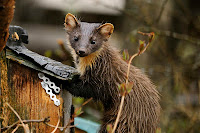
marten put its head in the feeder. Despite the noise of the cameras mirror clunking up and down the marten continued to feed eventually jumping down from the fence and heading off into the woods. With patience most chalet guests were also able to see the marten, the animal being bold enough to allow the chalet door to be opened for the guests to get an even better photo opportunity. Brilliant! A visit to the garage in Grantown is always welcome (apart from the bill) as it allows for a recording visit in the general area whilst the car is being looked at, and, with the MOT about to run out on the 1st May, I deposited the car with Mike and started to work my way back through the aspens, hazels and birches by the River Spey towards Nethybridge. The first thing to turn up was a puss moth larval case on an aspen and whilst giving a leaning
willow a thorough lichen search, a blackbirds nest with 5 eggs was found, ensuring a rapid departure to allow the bird back to incubate. More of the aspen twig fungus Encoelia fasicularis was found as was a strange bit of “management” - ring-barking a few aspens to within an inch or so of their lives. This experiment I gather, is to try and stress the aspens into producing flowers, something the aspens rarely do, in the hope that more seed would be produced. Aspen trees are either male or female and because they flower very rarely, there is little chance of trees of either sex being in flower in the same year or close enough to one another to ensure cross-fertilisation and hence they rarely produce seed. Most aspen stands locally
reproduce from root suckers and whilst this is very successful providing grazing pressures are low, it does mean that most trees are clones of themselves which could be a problem should growing conditions change or infectious diseases appear. The ring-barking that I saw involved a section of bark, about an inch wide, removed in a spiral around the trunk of the tree, but ensuring the start and end of the bark removal didn’t meet otherwise the tree would die. The management does look very damaging and will probably weaken the tree in years to come, but I will be interested to know how successful the trial has been and whether fertile seed was produced.

The bonny wee flower moschatel (Adoxa moschatellina) has featured a little this month with a new site being found during a visit to the Tulloch aspens. In this particular stand some of the biggest aspens in the area occur and a few of the trees have shed, in the last couple of years, some huge limbs. More of the aspen
twig fungus was found (close to the site of the original first find) and on the younger branches and twigs of one of the fallen limbs the crustose lichen Lecanora populicola was found in abundance. Knowing this lichen was present I made a search for its parasite the lichen Candelariella superdistans, the UK BAP Priority species which appeared previously in the March 2013 diary. I first found a few tiny yellow apothecia on the Lecanora, then a few more, and more, and more, a huge population (above right) on several branches and the biggest population I have yet encountered and probably the size of the population
linked directly to the great age of the aspen from which the limb had fallen. Under the fallen limb I found a few leaves of what I was sure was moschatel, though, growing with lots of wood anemone with very similar leaves, I wasn’t 100% certain. A wider search produced a few flowers, saving lots of head scratching. This turned out to be a completely new site for the plant and quite a way from the nearest, known population. A few days later ex work colleague Andy emailed to say that he had also found a new site for the flower on the bank of the River Spey in Morayshire and that he had noted that many of the leaves were covered in black “dots”. Last year I had made an unsuccessful search for a rust fungus only found on moschatel – Puccinia adoxae – Moschatel Rust, so there had to be a good chance that this was what I had been looking for. So, armed with a reasonable description of the location, I visited the site the next day and after a
bit of wandering back and forth as you usually do on plant searches, I spotted the first group of “townhall clock” flowers, so named because the square flower-head has flowers on all four sides of the square along with more on the top. All over the leaves and some stems and even some flowers where lots of black dots of the rust fungus, all I needed to do now was check the spores under the microscope to be sure that I had the right thing. Back home, a light tap of one of the leaves deposited lots of spores onto the glass slide and sure enough the spores (above right) turned out to be brown, angular and definitely belonging to the Moschatel Rust. Thanks Andy. To encourage folk to go and have a look at any moschatel patches they might know about I sent details of my record to the Highland Biological Recording Group which produced an interesting result, see 19 May entry and 2 May entry (should be 20 May) on the HBRG website given below.

An outing on the 16th brought back memories of a desperate dash up the A9 some 30+ years ago. With the weather getting a little better I made the first of 3 visits to my woodcock survey site, the same location as had been used ten years previously and mentioned in the last diary. Sunset time for this first visit was stated as 9.30pm, so the count would start at 9.15 and end at 10.30, so I left the house at 7.30 to ensure I was on site well ahead of the start time. The walk in was pleasant enough but with a lump of cloud starting to cover the distant Cairngorms. As I approached the Sluggan Bridge I noticed lots of activity, and tent and loos were being installed for an event that would be passing through at the weekend. The last thing I thought I would encounter was lots of other people en-route to my recording location. Once in place I put on the extra layers of waterproofs to keep warm and up above in the woodland a couple of ravens were calling,
something unusual in this part of the world in May as there are very few records of these birds breeding locally. The evening chorus of bird song was excellent and I tried to keep a note of which was the last bird to be heard singing as darkness fell – a robin. I had been recording for 15 minutes when the first roding woodcock sailed overhead calling, with probably the same bird going round again 2 minutes later. The last bird was heard roding at 10.30 just as I was packing up to go and all told there were 15 records of birds seen or heard during the recording period. All the records were of single birds so this could have been the same bird circling its territory for the whole of the period I was on site. The BTO ask that all contacts are listed and it will be up to them to do the analysis of what the 15 contacts mean. A tawny owl called for the last half an hour and a bat, assume pipistrelle, regularly flew along the track where I was standing. Despite the increasing darkness the half hour walk back to the car was achieved without incident. In the car a brilliant bit of World Music was playing on the radio and as I made my way under the A9 as I entered Carrbridge, I remembered the 1am charge up the same road some 32 years earlier as I drove a very noisy Janet along with a two year old daughter to Raigmore. After watching TV and taking a late evening bath, Janet decided that baby number two was on its way so we all piled into the car and headed north at great speed with young Laura wondering why mum seemed so distressed. Just after Tomatin I noticed a car parked by the road in a very suspicious location, knowing there was a peregrine site nearby, but as Janet gave out another almighty howl, I knew that now would not be a good time to stop and investigate! On arrival at Raigmore (warned of our arrival by phone before setting off) a couple of nurses were ready to wheel Janet away to the words of “oh my God” as they realised baby Ruth was on her way out. A few days later I heard that a peregrine nest close to the A9 had been robbed! I drove home from my survey at a more leisurely pace to a bit more brilliant World Music and thoughts of all that had happened during the last 32 years.

The second woodcock survey visit about 10 days later wasn’t without it own surprises either. Sunset on this occasion was at 9.45pm so counting would commence at 9.30 and end at 10.45. Once again there was a bit of activity at Sluggan Bridge, a tractor was parked and a barbeque seemed to be underway a little way up river by a big tent. Tonight the Cairngorms were lit by the setting sun and there was going to be a clear sky for my return and I was trying to remember whether this was full moon night. No ravens on this visit but both robin and song thrush were still singing at the end of my recording period. Again, the first woodcocks appeared 15 minutes into the count period with two birds roding and chasing. 10 contacts were recorded with 2 birds seen or heard on 3 occasions. As I made my way back along the forest track I was getting an occasional hint that there was a moon appearing over the horizon but it wasn’t until I had descended down
through a bit of dense plantation that I could see that a full moon was just above the hills opposite. Thoughts of a photo of moon, bridge and possibly the river started to form in my mind as I hurried down the track to see if the moon would be in the right place – above the bridge. Bingo, bridge and moon were perfectly in line, time for a few photos, despite the darkness. The barbeque up river was still on the go despite the clock creeping toward 11.30pm. Close to the bridge I tried a few long-exposure shots of moon and bridge but eventually thought a bit of flash wouldn’t go amiss, just to try and get a bit of light onto the stonework of the bridge. By now it was quite dark so I tried to shield the flash from the folk at the barbeque and after a few shots packed up my gear to head off home. As I approached the bridge I realised that a couple of people were just ahead of me and also heading for the bridge, so I made my Leki poles make a bit more noise so that they were aware that I was just behind them. The man and lady stopped by the tractor as this was to be their transport home and as I approach, the man said hello and commented on the “bonny” night. I then realised who was speaking (Frank, the sporting manager for the estate) and I replied that I didn’t expect to see him out there at that time of night! Amazing what you see when you go counting woodcock!

Professor George Dickie also reappeared during the month. The experts at Kew were looking at my third ascomycete fungus found on twinflower leaves at the end of the last diary and eventually an email arrived to say the Puni had managed to find some “immature conidia” (fungal spores) and that there was no doubt that the fungus was a Septoria (below) and after further work, concluded that it was Septoria linnaeae. This find proved
even more intriguing than the Sphaerulina leightonii covered in the last diary. The Septoria isn’t listed in the Fungal Record Database of Britain and Ireland but was mentioned in a paper by W. B. Grove in 1935. Amazingly, the Kew team managed to trace the single British specimen of this fungus, the one Grove was referring to, in the Kew collection and the only information they could find about the specimen was that it was collected by George Dickie, before 1879, from Linnaea borealis in Aberdeenshire. Phew! So my collections made from this one plant, twinflower, have produced 3 species of ascomycetes (fungi) that have rarely been recorded previously in the UK, obviously there is still a lot more to find out there.

Another anniversary occurred this month – Mount Everest was climbed 60 years ago, that is unless George Mallory and Andrew Irvine got there first! Whatever, on the 29 May 1953 we definitely know that Edmund Hillary and Sherpa Tenzing Norgay made it to the top, a great achievement. However, it is the story of
Mallory and Irvine that is the more amazing, climbing high on Everest with their hob-nailed boots and tweed clothing 29 years before the success of Hillary and Tenzing. After 3 expeditions to Everest Mallory deserved to make it and it was such a pity that when his frozen body was found in 1999 he wasn’t the man carrying the camera, the body of Irvine has never been found. The photograph Mallory carried of his wife, to leave on the summit, wasn’t on his body either – adding to the “did they make it” theory. Compared to the 1953 expedition, funding was tight for the 1924 attempt and as a fund raising initiative by John Noel, the official expedition photographer, members of the public paid to receive a postcard from Everest to help raise funds. As a youngster, I, like many of my friends, started to collect stamps, and with the help of mum and dad a stamp album was bought and stamps from various sources were collected. A friend of my dads father was also a keen collector of coins, eggs and stamps during the late 1800s and early 1900s and long after he had died I
would visit his son’s house with my dad to ogle at these great collections. Before it was illegal a few bird’s eggs were given to me with data cards from the 1890s along with a Roman coin found when houses were built close to a Roman fort somewhere in Lancashire and when he heard that I had a fledgling stamp collection he gave me one of those postcards from the 1924 Everest Expedition. There is little value in these postcards but to be privileged enough to be the owner of something linked to that famous but tragic expedition was immense.

After a partnership lasting several decades and having travelled many, many miles I said goodbye to my trusty old rucksack. Janet had done sterling work keeping the whole thing sewn together but with shoulder straps fraying beyond repair and the fastening clips suffering from old plastic brittleness the time had come to say cheerio. Like old boots how do you choose the right replacement? Most sacs nowadays seem to be all about how many straps you can attach to them so I was dreading making a choice. On a visit to Aviemore I
knew the deed had to be done so I visited all the shops to see what the options were in the 25 litre range. Zips, straps, air flow options I was loosing the will to progress but a green job in Black’s seemed close to what I needed and after my visit to Brighams failed to impress, I returned to Blacks to look again at the bright green job. A lid with a clip rather than a zip, a breast strap, a rain cover in its base, fairly comfortable to wear – sold to the man in need of a new hat – which I have yet to buy. I can’t get rid of two old friends in one go! In the field the Lowe Alpine Airzone 24 has done all that I could have asked and amazingly seems lighter on the shoulders despite carrying all the same gear. I just hope it is good at finding things!

That’s it for another month, sorry for the delay which will become obvious next month, enjoy the read.  I am hoping to add a few extra "blogs" to cover details of some of the fungi along with their spores.

Stewart and Janet

A bit about the Everest stamp
http://www.mountainstamp.com/Nepal%20pages/Everest.html

Highland Biological Recording Group website
http://www.hbrg.org.uk/Latest.html

BTO Woodcock Survey
http://www.bto.org/volunteer-surveys/woodcock-survey


Janet at her stall at the Spring Gathering in Nethy


Morchella elata found locally


The new Nethybridge pond

Photos © Stewart Taylor