Wednesday, 22 October 2014

Thank you Scotland

September 2014, a month in our lives that I hope we will never have to go through again.  Even now, writing this, I feel very emotional as I re-live the weeks, days and hours leading up to the 18 September 2014.  Exactly how Janet and myself were feeling as the day drew closer was summed up brilliantly by Melanie Reid in her article in The Times on 16 September “My grandfather, a crofter, would think this is madness”, where she talks about
the changes felt in her local community as September approached, the feeling of being “wretched, scared and absolutely powerless” as those of us who were “emotionally British” contemplated “divorce from the UK”.  Everything we had worked for during our lives houses, pensions, jobs and savings as honest citizens of the UK seemed no longer secure particularly when what was being offered was jam tomorrow.  “Political fantasy” summed up pretty well what many folk were thinking.  A note in my diary on the 13th said “feeling a bit off colour” perhaps after watching the Last Night of the Proms and wondering if this would be the last time this would be a national event with live links to Wales, Scotland, Northern Ireland and England.  The “off colour” entry continued to appear over the next few days not making the obvious link that the 18th had something to do with
About 5am in the morning
it.  We both went down to vote quite early on the 18th and, very oddly for me, I completely ignored the “good morning” welcome from the Yes representative at the door.  I was feeling there was very little good in the potential break-up of the UK.  I spent the rest of the day away from radio and TV in a bog I had helped to restore for RSPB Scotland in the biggest of the UKs National Parks.  The thousands of records I had collected over the years were aimed at showing why Abernethy and other sites visited locally were important to the UK and I was trying hard to see whether I would have the same motivation if this was just for Scotland.  Scotland is brilliant, but brilliant and key to the
The saviour of sanity Mycena
importance of the UK.  The link was highlighted very well by the fact that I was in the bog following up a request from the Mycologist at the Royal Botanic Gardens, Kew, to look for something growing on a sedge that was thought to be extinct.  It wasn’t found but a bonny wee red Mycena fungus found in deep, wet sphagnum moss kept my mind occupied through the evening, arriving at a name at about the time the polls closed at 10pm.  We stayed up all night getting to bed at 6.45am knowing that 55% of the people voting had opted for Scotland to remain part of the UK.  No running up and down the street waving flags, no champagne, just hugs and a huge sense of relief.  The following day Janet put our money back in the bank!


Quite a lot of September was spent checking for species of interest on two important areas for biodiversity but both threatened by housing developments.  The local one in School Wood, Nethybridge has featured before in this blog and you get the feeling that the folk behind the application keep re-applying in the hope of wearing down the locals who have made the effort to object on more than one occasion.  The second one is also a long-
Sarcodon sqamosus the size
of dinner plates
running affair based on a very important grassland in Carrbridge with the development also requiring several hectares of woodland to be felled.  The reason for getting involved in both is to try and get long-lasting protection for both sites but also to highlight the inadequacies of the folk employed by the developers to undertake the biodiversity surveys.  These surveys do seem to be written trying to show why the development should go ahead rather than just report on what is there and the importance of any species found.  Carrbridge was the most urgent and the local conservation group
Not quite so big Sarcodon glaucopus
now known as Sarcodon scabrosus sensu str.
(Badenoch and Strathspey Conservation Group - BSCG) had asked for help in recording species and for help with identifying some of the fungi found.  The woodland, mainly Scots pine of planted origin, was re-checked for tooth fungi, several of which had been found prior to an earlier application.  Several were found, the most amazing being the good numbers of the dinner plate sized Sarcodons, both S. squamosus and S. glaucopus now S. scabrosus sensu str., many associated with the areas of old badger diggings.  As the month progressed the focus turned to the natural grassland (fields that have never been ploughed or fertilised an increasingly rare habitat in the UK) to see which waxcap fungi were emerging, the main indicators of the quality of the grassland supporting them.  Waxcaps featured in last month’s blog but the big problem is not the finding, of which 6 species were found, it’s the identifying.  One or two are very obvious but the red and yellow species need microscope work as do
Clavulinopsis corniculata - Meadow coral
the darker coloured species.  An hour in the field lead to two nights work with the microscope and the realisation that more experience is needed with gill edges and cap trauma to be really happy that the ID is 100%.  The field also produced both yellow and white “spindles”, Clavulinopsis helvola and Clavaria fragilis, yellow meadow coral and the oddly named and multi-coloured parrot waxcap – Hygrocybe psittacina.  A group of grey coloured round “stones” turned out to be one of the brown
Parrot waxcap - Hygrocybe psittacina
puffball, (Bovista nigrescens) the one you tend to find later in the year, the “ball” having detached itself from the ground and often to be found blowing around in the wind shedding its spores as it goes.  None of these species featured in the developer’s survey possibly not too surprising when a botanist undertook the survey rather than an experienced mycologist.  Perhaps the most amazing bit of the fungi survey report was that a fungus found was 90% a Hydnellum but only 70% sure it was ferrunginium!  In my recording world a species either is what you see or it’s not, no if’s or but’s.  If the surveyor had been correct, it would have been the first ever record of a Hydnellum growing from
The stone-like puffball Bovista nigrescens
a tree root.  Thankfully Charles Darwin didn’t have this problem!  A second visit to School Wood produced a few nice surprises.  Several sites were found for the green shield moss with one root-plate of a blown Norway spruce having a population of 48 “new” capsules from this growing season, all well developed and the highest count of whole capsules found to date at a single site.  It is unlikely they will all survive to maturity (May 2015) once the predator (still unknown) of capsules finds them.  One to follow up in the coming months.  Close checking of mossy roots and fallen trees lead to the finding of a population of small black balls on the tips of one of the common woodland mosses Mnium hornum.  Photos were taken and a small section of moss with balls taken home to check.  It
Didymium minus on moss
was obviously a fungus so the first thing to do was cut a ball in half and squash it under glass to check under the microscope.  The outer shell was so hard that the extremely thin glass cover-slip broke before it was possible to squash it, but with a bit more care a squash was achieved and lots of round, brown spores were seen.  I had a suspicion that what I had found was a young slime mould and without the UK’s slime mould expert living not too far away, I probably wouldn’t have bothered taking the sample.  Photos were emailed to expert Bruce and back came the name Didymium minus, with few records on the fungal database, probably reflecting more on the lack of folk like me, bum in the air, poking around the bases of spruces!  With expert mycologist Liz incredibly busy I made a trip over to Deeside to undertake a count of the number of fruiting bodies of the spruce tooth (Bankera violascens) at one of only two known UK sites.  The other site featured in the August blog and my
Didymium minus spores x1000
notebook lists 85 fruiting bodies seen in that wood but a full survey would have shown there to be well over 100.  The Deeside site is on Forestry Commission land and during the last thinning of the trees, the sitka spruces close to the track where the fungus grows were left un-thinned to ensure the habitat remained suitable for it.  A walk along both sides of the track produced 50 fruiting bodies, many of which were quite small possibly reflecting the dryish summer.  Lunch by the River Dee showed just how high the river had been during the big rainfall of the night of 10-11 August.  Standing on the shore the debris stuck in the trees overhead showed this big river had been 2-3 metres higher than normal. 

The pine martens have been a regular feature in the garden this month, one visiting the squirrel feeder at one-o-clock in the afternoon, but mostly in the evening.  Daughter Laura passed through mid-month to leave her cat with us for a few days and around the same time Janet put an additional plate
of currants out on the garden decking, viewable through our glass doors.  Laura’s marten luck held, and as we all sat chatting at about 8pm her cat was very interested in something on the decking – a visiting marten!  As everyone watched the cat watching the marten I grabbed the camera to try and get an unusual photo of cat and marten.  At the same time our own cat joined the watchers and with a bit of difficulty I fired off a few shots of cats and marten though house lights and outside darkness
Pine marten via the wee Lumix camera
produced a photo but not of the best quality.  We are fairly certain that one or two martens are currently visiting every evening/night much to the delight of our chalet guests.  An outing with members of the BSBI to record plants in and along the shore of Lochindorb on Dava Moor on 14th provided two viewings of a fishing osprey, long after the Loch Garten birds had departed.  The aim of the outing was to check if plants recorded previously, up to two decades ago, were still present in or on the shore of the loch.  Amazingly, the day was very calm which was just as well, many of the plants were being looked for by paddling along the edge of the loch peering down into the water.  This loch is quite unusual in that along the shores we were visiting, the loch is quite shallow, often for many metres from the shore, though visitors to the loch must have wondered why up to a dozen
The Lochindorb searchers
folk were “paddling”, well out from the shore, and peering down into the clear waters.  Having spent very little time studying aquatic plants it was quite useful having expert Ian as leader and very quickly plants like shoreweed (Littorella uniflora), alternate water-milfoil (Myriophyllum alterniflorum) and the rarer plants like quillwort (Isoetes lacustris) and water lobelia (Lobelia dortmanna) were found as washed up specimens on the loch shore.  In all about 150 plant species were recorded, re-finding several species that hadn’t been seen at the loch for quite a while.  Phil, who had travelled up from the Lake District for the outing, also gave us a useful tip for identifying
The striped ladybird Myzia oblongoguttata
the three short-leaved aquatics many of which are only found as parts of plants on the shore-line.  Shoreweed leaves when cut have a solid core, water lobelia has two tubes/holes visible on the cut sections and quillwort has four holes, a very useful guide when externally the leaves of the three species look very similar.  The latter is also a spore bearing plant closely related to the clubmoss family.  A visit to a wee burn flowing into the loch produced a single ladybird perched on a sedge which turned out to be the striped ladybird (Myzia oblongoguttata).  A good day out and I just hope the names of the new plants “stick” so as to help with visits to other local water-bodies. 


Early in September an email from Martyn at Kew brought some interesting news – “Good news about your little smut haul from 2013!”  This followed quite a bit of sedge checking, just a year earlier, when I had been finding the black fungal balls of Anthracoidea fungi.  At the time of the collections the carrot had been dangled that not a lot was known about this group of fungi and that
Anthracoidea inclusa on bottle sedge
any collections would be welcome and some might possibly be new to the UK!  With generous financial support from the Esmée Fairbairn Foundation, Kew has embarked on the Lost & Found Fungi Project following up on species of fungi with only one or few recent records.  Are these fungi genuinely rare or simply rarely recorded?  This funding allowed my collection to be checked and the correct name given to the fungus associated with each sedge.  Amazingly, the smut found on one of the commonest sedges locally and nationally, bottle sedge (Carex rostrata), was the first known British record of Anthracoidea inclusa!  A less common sedge, slender sedge (Carex lasiocarpa) also
Anthracoidea lasiocarpae on slender sedge
produced a first, Anthracoidea lasiocarpae.  Brilliant.  Both collections were made from the extensive sedge beds associated with Insh Marshes and they produced the perfect outcome to a nice wee project.  The next carrot though has been dangled which might not be too easy to find.  A small fungus of the family Puccinia has been recorded once on the leaves of the slender sedge and is now thought to be extinct.  Sedge beds have been visited but with the big flood on the 10/11 August many of the sedges are covered in mud and debris and though collections were made these will have to be held over until further searches can be made in August 2015.

After involvement going back to 1977, I walked my last Loch Garten butterfly transect on the 23rd before hanging up my net, in what has been quite a good year, though it didn’t feel that way as each
Butterflies and anything else on last transect
walk was completed.  Just two walks were missed, the first two in April due to weather.  For many of the walks just 3 or 4 species are seen with the last two having just 1 species per week.  The biggest counts occurred during late July and early August (max 264 on 5 August) and the highest number of species on a single walk was 9 on 22 July.  Speckled wood was a new species for the transect and green-veined whites were the most regularly recorded species with 585 individual contacts.  The table below summarises the 2014 season.

2014


Species
2009
2010
2011
2012
2013
2014
Small White
0
0
0
1
0
0
Green-veined White
221
151
113
125
307
585
Orange-tip
15
8
20
17
7
20
Green Hairstreak
20
18
33
6
2
10
Northern Brown Argus
0
1
0
0
0
0
Common Blue
6
5
3
2
3
8
Red Admiral
5
0
1
0
0
4
Painted Lady
2
0
0
0
0
0
Small Tortoiseshell
15
11
17
14
29
16
Peacock
5
1
1
2
0
2
Small Pearl-bordered Frit
28
22
22
5
9
9
Dark Green Fritillary
20
7
5
4
5
7
Speckled Wood


1
Scotch Argus
136
442
299
759
420
515
Meadow Brown
12
4
2
2
1
6
Ringlet
115
231
105
108
83
284
Small Heath
11
20
15
20
21
96
Large Heath
2
4
2
1
0
0
Total butterflies
613
925
638
1066
887
1563
Number species recorded
15
14
14
14
11
14
Weeks walked (out of 26 max)
23
20
21
23
23
24

Having retained annual totals over the 38 years it is interesting to see how the species recorded have changed with 2 species lost in the 1980s (dingy skipper & pearl bordered fritillary) but with 3 new-comers during the 2000s (peacock, speckled wood and ringlet).  Clouded yellow appeared just once in 1992, the year of the big invasion.  Whilst the table below shows what appeared when and how often, a little caution is needed in that during the period 1990 to 2002 there were two years with few transects walked, and three years with none at all.  It can be seen though from the table that 2014 was the best year to date for contacts of green-veined white and ringlet and also for the highest number of contacts made for all species.  My own involvement covered 20 years with the biggest benefit coming from all the other species recorded for the Abernethy Reserve, in addition to the butterflies.  The last record locally for the small dark yellow underwing moth (Anarta cordigera) came from the transect
Exobasidium sydowianum on bearberry leaves
along with several shield bugs, a rare tooth fungus, several fungi including just the 7th UK record for one on bearberry leaves (Arctostaphylos uva-ursi) during this September and the occasional plant.  Hopefully, RSPB will be able to find a suitable person to keep the survey going despite the commitment of one walk a week from 1 April to 26 September.  It has been great to have been a part of the UK Butterfly Monitoring Scheme and when you next hear about the ups and downs of our butterfly populations nationally, it is this scheme which is providing the data.  Currently there are over 1,000 sites being monitored annually and since its inception in 1976 recorders have made about a quarter of a million weekly visits at more than 1500 different sites, walking over a third of a million miles and counting over 16 million butterflies.
1977 to 2014


Species
max count
year
years recorded
first
last
Dingy Skipper
28
1978
8

1987
Clouded yellow
1
1992
1


Large White
26
2006
13


Small White
4
2006
10


Green-veined White
585
2014
35


Orange-tip
22
1977
32


Green Hairstreak
33
2011
32


Small Copper
23
1989
17


Northern Brown Argus
13
2006
4


Common Blue
150
1984
31


Red Admiral
65
2004
18


Painted Lady
28
2006
6


Small Tortoiseshell
99
2004
35


Peacock
22
2006
10
2004

Small Pearl-bordered Fritillary
118
1978
28


Pearl-bordered Fritillary
11
1984
10

1989
Dark Green Fritillary
26
2006
22


Speckled Wood
1
2014
1
2014

Scotch Argus
759
2012
34


Meadow Brown
54
2006
33


Ringlet
284
2014
10
2005

Small Heath
109
1978
32


Large Heath
20
1984
28


Maximum count in a single year
1563
2014


Transect started                     1977
Total possible years                  38
Total years walks completed   35

During September swallows and house martins were gathering in preparation for heading south.  Whilst visiting daughter Ruth near Aviemore I had been seeing increasing numbers of swallows on the fences and overhead wires and as the family parties met up I was amazed one day to see what looked like over 100 birds flying round her house and occasionally landing in a nearby half-dead
Ruth's swallows
tree.  I quickly grabbed the wee Panasonic camera and waited to see if they would land again, which they did briefly.  I think the photo shows up to 90 birds in or around the tree.  Despite waiting for them to repeat the tree visit they scattered and landed in various places.  The possibility of a lot of these birds having bred or hatched on the estate where Ruth lives is quite feasible with so many older buildings and barns around the place with open windows and doors allowing easy access to lots of nesting sites.  With many fields having been harvested there were additional feeding opportunities for
other birds and the local rooks and jackdaws have been wandering the fields in big numbers.  A visit to Cawdor saw cereal harvesting in action with the crop being deposited into the drying areas attached to the local distillery and with the sun shining no doubt the combine would have been working late into the evening.  A little worrying though was the quantity of fertiliser sitting in the
Heath cudweed seed heads
adjacent farm-yard ready for the ploughing and sowing of next year’s crop – 140 one tonne bags of the stuff, probably indicating why the plants of rest harrow and field speedwell were only found on the field margins.  Heath cudweed (Gnaphalium sylvaticum) plants featured again this month though not in record numbers as in July.  A visit to an ex-garden cum nursery near Boat of Garten to check
Ouch!
for plants and lichens lead me to the first group of plants, mostly producing their fluffy seeds, with just over 100 plants in the group.  The old car park produced another 200 and the other tracks and visitor areas a few hundred more adding up to 660 plants in all, a not insignificant count.  Old tracks and car parks are ideal for this plant and if the site remains as it is, the population should grow a little before other plants take over.  Whilst lying down taking photos I was aware of lots of mosquitoes buzzing around with the occasional one penetrating my skin for a pre-breeding snack.  I’m not sure whether it’s me or the mozzies bites not being as itchy/inflamed as usual, but despite lots of bites

during the summer, few have created the itchy lump that would normally appear.  Feeling a bit sadistic I got the camera ready and held out my hand waiting for the next mozzie to land and, with fly in focus I waited for the bite, the proboscis to go red and for the body to fill with MY blood.  As usual the mosquitoes back leg was in the air as its body filled with blood and I managed to get my photos.  To see how much blood I’d lost I gently squashed the fly and the back of my hand looked like it had suffered quite a bit of trauma, and yet again no itchy lump developed!

Enough.  That’s it for another month 
Enjoy the read from a very relieved
Stewart and Janet

Badenoch & Strathspey Conservation Group
RBG Kew “Lost and Found” project
Esmée Fairburn Foundation, funder of Kew Project
UK Butterfly Monitoring Scheme
BSBI
Highland Biological Recording Group
and how to join HBRG

One of 30 turnstones flicking stones at Findhorn Bay
Findhorn Bay
Pinkfeet arriving mid-month
Couldn't resist one of Harry -"up and running"

Photos © Stewart Taylor


Wednesday, 17 September 2014

A “Thunderous” month as we swap flowers for fungi

As I type we have probably seen the last few curlews depart, the Loch Garten ospreys have headed south at the end of another successful year, and everywhere we seem to be seeing swallows gathering on wires and feeding over lochs and fields as they also prepare to head south.  It’s also getting darker in the evenings, but robins have started singing again at dawn around about 6am.  The early part of August saw me visiting the last two plant recording tetrads (2 x 2 km squares) down at Insh and Newtonmore, the Insh site producing the only site for moonwort during the summer survey of under-recorded plant areas within the Cairngorms National Park.  In all, 15 outings were made to cover my commitment of 5 tetrads with the first outing in early June and my last in the first week of August.  A total of 3500 plant records were made covering moorland species on the tops of hills at 550 metres to the wide mix of habitats in woodland, fields, stream-sides and lochs.  I have yet to work
Gland hairs on prickly sow thistle
out just how many plant species were found but heather featured a lot as did several sedge species and some of the speedwells.  One plant that caused a few problems when found was prickly sow thistle (Sonchus asper), however its spiky leaves clasping the stem quite tightly helped, and a check of the dandelion type seeds under the microscope ensured I had the
Seed - prickly sow thistle
right species.  The smooth sow thistle (Sonchus oleraceus) can be quite similar but under the microscope the seeds lacked the “transverse wrinkling between the ribs” found in that species. I have recently visited a site for this sow thistle and now having seen it in the flesh
Seed - smooth sow thistle
can see there is really no comparison.  Thankfully, all hawkweeds were recorded as just that, the plants being just too difficult to identify to species apart from the obvious ones.  Butterflies and dragonflies were recorded as found and a road-side wall near Insh village produced a good population of Peltigera britannica, the nearest recent record being my find in Inshriach Forest in 2011.  The Newtonmore outing also produced something that wasn’t so welcome.  At the end of July I attended a botanical recording evening on Crown Estate land near the Lecht ski area with the aim of trying to re-find hairy stonecrop (Sedum villosum).  This involved following a small burn, the plant often being found in seepage lines close to running water.  As we walked along we came across one of the heavily used management “tools” employed on sporting estates, a fenn trap placed on a log across drains or small burns.  The land we were on is let by the Crown Estate to sporting interests and
Peltigera britannica
grouse shooting is one of the main objectives, so the land would be under quite heavy predator control.  Fenn traps placed on logs over burns, and with a protective cage on top, is a legal way of controlling small predators like stoats and weasles, provided they are checked regularly.  Inside the cage and held in the jaws of the trap was an adult dipper which was long dead showing the trap wasn’t regularly checked.  The trap was also set within a hundred metres of a way-marked path which was a bit of a surprise.  I’ve seen a mouse caught in one of these traps but never a bird – until this year.  On my outing near Newtonmore I firstly came across the biggest number of red-legged partridges I’ve ever
dead dipper
seen, birds presumably reared for sport shooting later in the year.  We can’t retain our native grey partridge as a breeder in this area so these birds are reared and released as a “substitute”.  Having completed the major part of my plant recording walk I was on my way back to the car when I though a small burn might produce a few more plant records for the day.  Lemon-scented fern was found by the burn along with lesser spearwort as was a log based trap.  The trap wasn’t even operational with the fenn trap lying on the ground by the log and again a wild bird was held in its jaws.  So much for regular checking which, if it had been carried out, there wouldn’t have been any evidence of the wrong species being caught. 
unidentified bird in trap
Goodness knows just how many of these legal traps are out there in the countryside, along 800 metres of one of my butterfly transects I can count 4 of these, all openly visible from a public road.  So far, no birds.  If you want to follow a good blog trying to make sporting estates operate a little better see Mark Avery’s blog, Mark and his writing and petitioning is the reason why M&S have decided not to stock red grouse in their stores, worried that they could be found to be supporting the fact that in 20013 no hen harriers bred in England on grouse moors.

The early part of August saw Janet preparing for her Tweedcraft stall at the Abernethy Highland Games and with the tent installed on the 8th all was ready for the Games the following day.  Daughter Laura came over to help and with over 3000 visitors to see the running, dancing and pipe bands, her help was essential – I’m not too good at selling tweed
Massed pipe bands Abernethy Highland Games
bags and ear-warmers!  A bit of torrential rain during the night before the Games had us all worried but the weather for Saturday turned out just right for the event helping to ensure a good turn-out.  Events take place from about 10.30 on the morning of the Games with the official opening, by the special guest for the day at 1pm.  A minutes silence was observed in memory of those lost in the First World War a hundred years ago and this was followed by a “thank you” to Bill Templeton, our near neighbour, who had died that week and who had been a volunteer helper at the Games over many years.  With all the crafts delivered and
Wood ant nest after fire September 2013
installed in the tent I headed off home to spend some time checking sites for tooth fungi (more about that later) but also to re-visit the wood ant nest “destroyed” by fire a year earlier.  A visit to the nest a week after the fire let me see that many of the ants had survived
Same wood ant nest August 2014
(see October 2013 blog) and that they had already started to re-build the totally destroyed nest, so what would it be like 12 months after the fire?  I had seen some good progress via a visit in about May, but what I found on this visit was absolutely amazing.  Despite the surrounding woodland still showing all the evidence of the fire, the ants had been working their socks off, and a huge nest was there for all to see.  If I hadn’t seen and photographed the destroyed nest I would have been struggling to know that anything had happened as there in front of me was a nest whose base was almost as before and with its domed top probably two-thirds the height that it was before the fire.  This was a big nest before the fire and all I can assume is that many of the ants went deep underground during the fire and all
September 2013
were available to help with its re-construction once the fire was out and the damping down work had been completed.  A new nest starts off with just a few ants and over many years the domed structure starts to grow as the ant population grows.  However, this was a very large, well established nest and though no count can be easily made of the numbers in a nest, colonies can number up to half a million ants, though many of the big UK nests probably contain no more than 100,000 individuals.  If only half of that number survived the fire that
August 2014
is still a large number of very determined individuals tasked with re-building their nest.  Whatever, it was still an amazing sight to see such a large structure produce in just one year.  Well done ants!  My surprises though didn’t end there.  As I wandered around the fire site particularly in the area where the fire had started and smouldering probably for several days before “taking off”, burning so deep into the ground that two mature Scots pines had fallen over.  Around the edges of the root-hole craters I started to notice lots of quite shiny, dark
Pine fire fungus (Rhizina undulata)
shiny brown crust-like growths many with a bright yellow margin.  This had to be a fungus whose growth was directly linked to the fire and the more I looked around the more of them could be seen, some coalescing impressively together.  Hopefully this colourful fungus would be easy to identify in the books so a single sample was removed just in case spores needed to be checked.  The Collins Guide to British Mushrooms and Toadstools lead me to what else
Rhizina undulata spores x1000 (oil)
but the pine fire fungus (Rhizina undulata), a fungus whose spores lie dormant in the forest soil until activated by the heat of the fire and as they grow, the underground mycelium attacks the roots of adjacent pines possibly leading to their deaths.  Watch this space though the reaction won’t be in the same time-scale as the wood ants re-building their nest!

What happened a few days later would have been very welcomed if there was a forest fire.  At about 10pm it started to rain, something we had had little of during the previous few weeks and throughout the night the rain was heard battering down on the Firwood metal roof.  By 10am the following day it had stopped but during the twelve hours about 50mm of
Carrbridge pack-horse bridge with typical river flow
rain had fallen with possibly more in the surrounding hills.  I wandered down to see how high the River Nethy was and as I approached the roar of the water let me know that the river was incredibly high.  None of the usual rocks were visible and quite a bit of woodland debris was rushing by.  Despite taking lots of photos few gave a good interpretation of the height and speed of the flow so once home I thought it would be worth visiting the old pack-horse bridge in Carrbridge, the one, which a couple of weeks earlier had seen lots of the locals doing a bit of pool jumping during a nice warm spell.  Jumping off the bridge on the day after the rain would have seen a quick journey down the rivers to the coast with no survivors.  As I approached the road bridge adjacent to the pack-horse bridge one of the Carrbridge residents said I should have seen it a few hours earlier because by the time I arrive the water level had fallen by 6-7 feet!  Pictures of the bridge at the height of the spate
Carrbridge pack-horse bridge 11 August 2014
Photo © Andrew McMullen
appeared on national BBC news and quite a few folk made the trip to see something that has rarely been seen before, the River Dulnain gaining so much height that the parapets either side of the main arch of the bridge were also under water.  There were similar tales from Deeside and Glenlivet and in Kingussie the normally tiny Allt Mor over-topped its banks and washed away the road under the railway line where it crosses the B970.  Within a few days all rivers were back to normal and, apart from finding debris several feet up on the river banks, it was hard to see there had ever been a problem.  The local weather station, Straythspey Weather, found that August 2014 was the wettest month yet recorded since its records started in 2000, the 189.7mm beating the 155.9mm from April 2012.

Next year I should remember not to offer to take a group out to see the normally abundant tooth fungi.  I had to work hard to find many species in September 2013 after offering to take the local U3A out to see some, and, with something similar on offer to members of the Highland Biological Recording Group for the end of this month, I was once again struggling.  The need for a bit more rain probably during June and July was probably the
Hydnellum caeruleum
reason and I knew I was in trouble when the normally abundant Hydnellum peckii (devil’s tooth or bleeding tooth fungus) was nowhere to be found.  A little odd because at the end of June a single fruiting body of this species along with several of the normally rarer Hydnellum caeruleum (blue tooth) had already appeared by one of the tracks.  Added to this was a request from Maramedia (the timberman beetle film folk) to see if they could film some of the Abernethy tooth fungi for their forthcoming film for the BBC (Highlands: Scotland’s Wild Heart).  With this double request I started doing the rounds of the known
filming tooth fungi
fruiting spots, a little like the 5 year survey but on a smaller scale, and with time a few locations were being found though the devils tooth was being just that…a devil!.  It’s okay finding the fungi but when a two-day filming slot is entered into the diary there is then pressure on trying to find species that will be looking their best at that time.  Quite interestingly as I wandered I started to accumulate species so that as the filming days approached I had found all but one of the 14 species known to grow in Abernethy.  I did though have worries that the brown and blue/black species wouldn’t be “sexy” enough to make it onto your TV screens plus the fact that I had said the film team would need to involve expert Liz so that if they had queries about fungus ecology, the right person would be to hand (I just look for things!).  Despite searching and with only a few days to go before filming there was also the possibility that the cameras would head for Deeside where Liz had also found a few tooth fungi.  Five days to go and I came across a brilliant display of blue tooth, probably the most colourful for the cameras, but with temperatures into the twenties Celsius they soon dried, grew and lost their colour.  One fruiting body though, slightly
Pine bolete left with paler Cep on right
hidden under heather was still in good order and could meet the filming requirements.  Abernethy ended up as the place to do the filming and Liz drove over to meet up with Simon (Producer) and Raymond his cameraman.  Over the next three hours the blue tooth was filmed, then Liz was filmed undertaking typical recording activity along the track, followed by some beautiful Boletus edulis (Cep) and B. pinophilus (pine bolete).  There are huge populations of these edible Boletes this year probably thanks to the deluge.  Highlight of the mornings filming session was seeing over 60 swifts regularly feeding high overhead.  Mid-pm and it started to rain so we moved to check out the second area of good tooth fungi species in the hope that it would stop.  The rain stopped, the warmth returned and the
Liz & film crew brave the midges!
midges came out in there thousands just in time for Liz to do her bit to camera.  How they all stood still to film I don’t know and at one stage Raymond had to remove the lens filter because of the number of midges on it.  The midges might play a part in the final film there were so many clouds of them.  Day two and I returned to point out four tooth fungi species that might make good footage and left Simon and Raymond to do the filming.  As we parted Simon asked me to keep an eye open for any good fly agarics, probably our most colourful fungus, and I said cheerio.  As I drove back down the track a field with birch trees pinged a light on in my head so I parked up.  I looked for any colourful waxcaps in the field without success and eventually ended up in the birches where I couldn’t believe my eyes.  On a slight bank (100% perfect for filming, gills, stems and caps all visible) there were about 20 fruiting bodies of fly agarics, from newly emerged ones through to fully opened caps in red and white
Fly agaric (Amanita muscaria)
splendour and within half an hour I was saying cheerio again with a very happy film team in Agaric heaven.  With all the searching around, the afternoon visit by the HBRG members went very well, the leader knowing where all the species were, having visited the tooth fungi sites several times during the previous week.  We passed the occasional fly agaric but the visit ended with the visitors peering into a small hole, behind moss and heather, in an old quarry to see the tiny fruiting bodies of Hydnellum gracilipes, and despite this fungus being re-found in 2010 after being identified as new to Britain, the group were seeing a fungus that probably less than 50 people in the whole of the UK have set eyes on!  A total of 12 species were seen on the day with one other species to be checked.
The species seen on the day (total 12) are detailed below for the two sites visited:

Species
Speyside Way
Dell track
Species
Bankera fuligineoalba
*
*
*
Hydnellum aurantiacum

*
*
Hydnellum caeruleum
*

*
Hydnellum concrescens
to be checked

to be checked
Hydnellum ferrugineum

*
*
Hydnellum gracilipes

*
*
Hydnellum peckii
*
*
*
Hydnellum cf. scrobiculatum
*

*
Phellodon melaleucus
*

*
Phellodon niger

*
*
Phellodon tomentosus
*
*
*
Sarcodon glaucopus

*
*
Sarcodon squamosus

*
*


Grand Totals
6
9
12

Once again, the annual gathering of the Harley Davidson motorbike enthusiasts took place in Aviemore with their Thunder in the Glens “ride-out” taking place on the Saturday.  There was one big difference though this year – Janet had her craft stall in the heart of the
Harley Davidson camp
gathering in the Aviemore Centre!  The tent and crafts were set up on the Friday morning and ran through to the end of Sunday afternoon.  Despite the event having taken place over the last 18 years (with the ride-out probably a little more recent) we had never ventured into the heart of the gathering and it was quite an eye opener to see the scale of the set up in the Centre.  Trade stands, an avenue of tents selling everything from leather goods to kiddies windmills, and many outlets selling motorbike gear, with the thump of all-day music somewhere nearby.  We were never aware either of just how many participants camped on
£30,000 - each!
the Centre’s spacious lawns, all within a temporary security fence.  Packing the sales good up at the end of each day made for an early start next day to lay out all the tweed items again, but everything went off without a hitch.  An unusual experience but not too sure whether we will be regulars at future gatherings.  Having set up the stall on the Saturday I dashed home to prepare the chalet before grabbing camera gear to see the bikes pass by on the nearby A95, a place I had visited once before with grandson Finlay to see the bikes heading back to Aviemore at the end of the ride out.  The location was quite nice in that the Kincardine Hills
and the Cairngorm Mountains formed an unusual kind of back-drop, though whether this would come through in the photos we would have to wait and see.  About three-quarters of an hour after departing from Aviemore the first of the bikes arrived, all shapes, all sizes and all kinds of outfits.  The one big problem with photographing the bikes is that many have their headlights on, possibly on full beam, and this played havoc with the camera settings.  Lots of under-exposed photos but with a bit of off centre focusing quite a few turned out okay.  There was then just enough time to nip back to see Leeds Rhinos win the Challenge Cup after coming so close on many occasions over the last few years.  After setting up Janet’s stall on the Sunday there was just time in the afternoon to run a check on the horse field at the end of the road for waxcap fungi, just in case another planning application comes along
Hygrocybe conica
and the importance of the field for these fungi needs to be highlighted.  On the last count visit by Liz in 2010, 9 species were identified, and, doing the count just before her visit for the tooth fungi filming, I was able to get confirmation from her that another species had been added to the list - Hygrocybe acutoconia.  Sadly, the number of flowering spikes of field gentian was down to just over 200, down from around 600 on the last count.  Heaps of woodchips stored in parts of the field along with rain seepage from a huge pile of horse poo are not helping the situation.  Waxcaps are an indicator of fairly natural grassland where no ploughing or applications of fertiliser have taken place, a declining habitat worthy of looking after properly, if possible.  However, without any form of protection, this might not be possible.


With the tooth fungi filming team due I wondered whether the rare Bankera violascens had re-appeared in the Sitka spruce plantation near Forres and visiting the wood I could see several fruiting bodies, some newly emerged.  The floor of the spruce wood was covered in fungi most beyond my ID capability, but in the sides of some of the plough-lines there were lots of Phellodon melaleucus (the grey tooth) fruiting bodies, many cascading down the sides
Phellodon melaleucus
of the plough-lines and looking very photogenic.  A possible species for the film crew.  Fly agarics were starting to appear as was another fungus belonging to the “hare’s ear” group of fungi (Otidea).  Somewhere in the back of my brain I seemed to remember a request from Brian at Kew for samples of any of this group of fungi so I popped a couple into a box for checking and drying at home.  If you check any field guide on fungi you will usually see about three or four species described and often what you have collected will “match” one of these.  However, my MapMate database lists 8 species and if you go to the “bible” the FRDBI, you will find 12 species listed.  Hence the request for specimens to find out how many species Britain supports and to add a little more to our knowledge of their distribution.  A visit to the Dell Wood NNR spruce wood just up the road from Firwood again found lots of fungi fruiting with a similar looking Otidea species growing in good numbers in some areas.  The specimen I took home to check, dry and forward had spores which looked the same as my first collection, but we will see what Brian says (Otidea leporine confirmed).  A similar, but larger specimen was found a few days later near Cawdor and just up the road from the house the first “dark” Otidea was found on the roadside verge, the latter belonging to the “toad’s ear” group and could possibly be Otidea bufonia.  Watch this space.  This Dell Wood Norway spruce plantation has also started to give up new
Otedia leporine one of the "Toad's ear" fungi
locations for the green shield moss with at least 10 locations found so far.  Hopefully I can persuade owners SNH (Scottish Natural Heritage) to keep this interesting bit of woodland rather than pursue the removal of all exotic tree species policy (within designated sites) which has seen most of the same trees felled in Abernethy despite the fact that they also supported this rare moss.  Before the rains, the numbers of butterflies on the weekly transect
Scotch argus before the rains
were quite high, particularly for green-veined whites and scotch argus, the latter producing over 100 contacts again on just one count section, as a couple of years ago.  Down came the rains along with the first two frosts and the numbers dropped.  It was a real shame to see the state of the scotch argus butterflies encountered on the same count section a couple of weeks later.  Small heaths have been having a good year and it was nice to have a few contacts with
Scotch argus after the rains
dark green fritillaries though these were all related to a patch of flowering spear thistles which appeared after that section of the moor was burnt a couple of years ago.  So far, only two weekly walks have been missed due to poor weather conditions and these were the first two of the year which isn’t that unusual.  It would be good if I could manage to walk the last four of the year to complete an almost “full house”, something that might not have been achieved before.

That’s it for another month.  We vote tomorrow and have to hope that the ‘jam tomorrow’ folk fail in their bid to break up our UK.  Scotland has not been a nice place to be recently with all the uncertainty of the last few months.  Jam tomorrow – No Thanks.

Stewart and Janet

Prickly sow thistle
Mark Avery
Pine fire fungus (Rhizina undulate) a scientific paper
Strathspey Weather
FRDBI
BSBI
Highland Biological Recording Group
and how to join HBRG

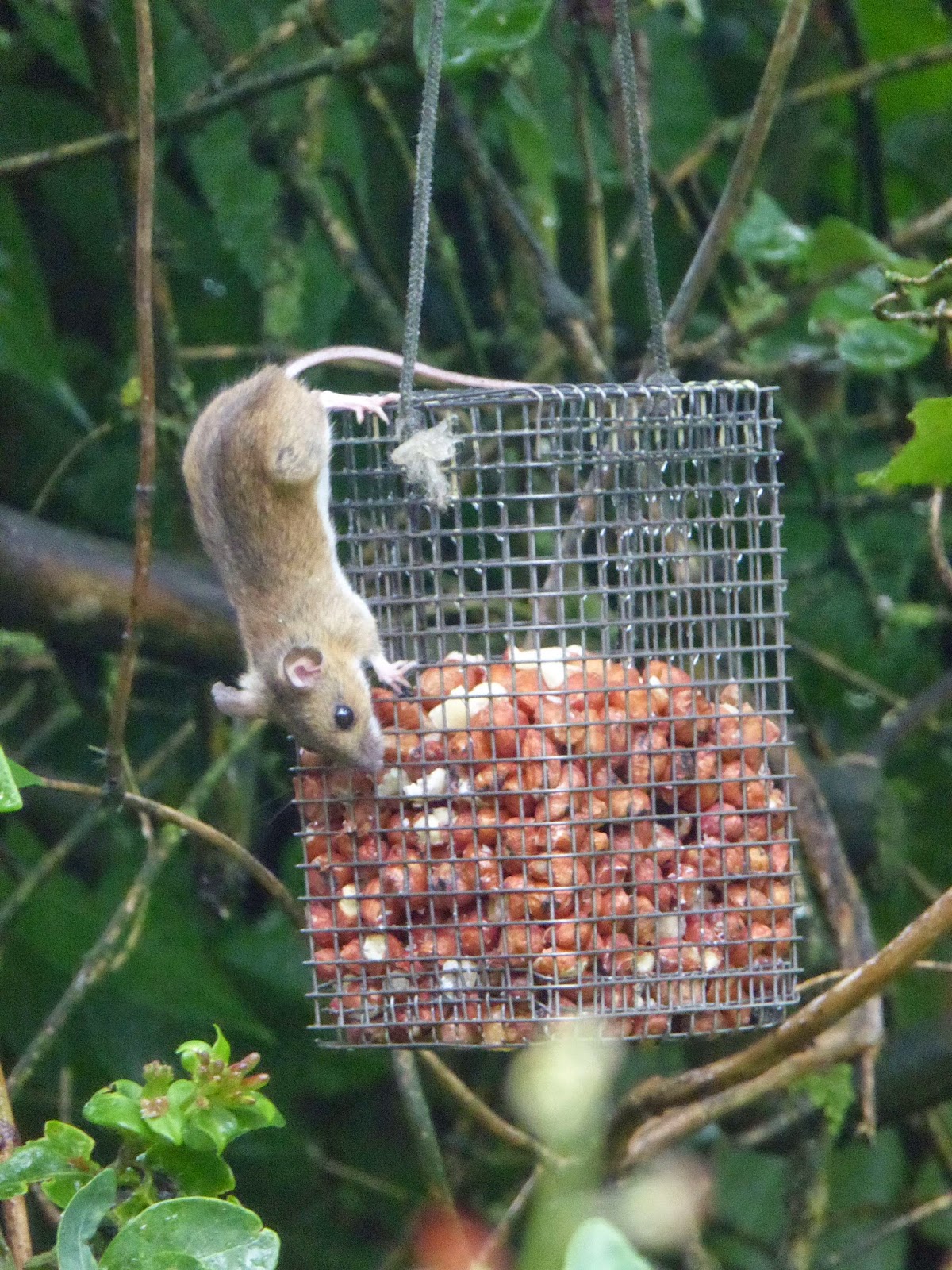
Mouse on peanut feeder - a first!
Frost & misty mornings return
Green lestes damselfly with prey

Photos © Stewart Taylor unless shown otherwise