 As I type this, the leaves are falling rapidly from the trees, the geese have arrived from their breeding grounds and, in a mild spell of weather a week ago, a lone red admiral and a small tortoiseshell butterfly were to be seen on the last of the buddleia flowers. The weather forecast for today is snow on high ground over the next couple of days. Help!
To find out why this man is so happy, read on.
With butterflies in mind I have to say what a struggle the Loch Garten butterfly transects were this year, but, having said that, the actual numbers recorded increased quite markedly from 2009. Many of the regulars were down in numbers but that
 recent arrival – the ringlet – doubled its numbers, and the Scotch argus had its best season for many, many years, showing an increase of over 300%. The long-distance migrants, red admiral & painted lady, failed to appear on the transect but overall the total number of species was only one down on last year, a single northern brown argus being the only gain. Transects were walked on 20 of the 26 weeks, 4 being missed due to cold weather in April and 2 through lack of sun in September. Quite a commitment. Details of the last two years of the survey are given above.
Looking back over the 26 weeks the highlights have to be re-finding the netted mountain moth, the regular views of the northern emerald dragonfly and recording the continued existence of the colony of six-spot burnet moths. Two new species of fungi were found for the Abernethy Reserve, Helvella macropus and Helvella lacunose, and shining guest ants were found on two new wood ant nests. So again, recording one thing has produce lots of good records of other species.
 Once again I got the weather wrong, sunny and calm at Firwood but not quite the same a bit higher up. In early September I had the opportunity to get a lift to the ex-Bynack Stable site at the bottom end of Strath Nethy and the chance to go looking for dragonflies high up on A’Choinneach at a location where I had seen Aeshna juncea way back in 1995, at what could be one of the highest recorded sites in UK. During the drive out several groups of Duke of Edinburgh gold award participants were on the move fro
 m their overnight camp sites. These groups were to be a feature of the whole day. Leaving the vehicle by the bridge over the River Nethy I realised that the benign conditions experienced in Nethybridge weren’t going to be a feature of the days walk. The tops were shrouded in clouds and the wind, forecast for tomorrow, had already arrived at this slightly higher elevation. A bit of a challenge and with not much chance of seeing any dragonflies. By the bridge were a couple of tents possibly a safety feature for any of the Duke of Edinburgh folk who might have to pull out from the hills, a nice picture against the dark mountains. The first hour was spent walking through the lower peaty section of the strath and an hour and a bit later I was looking from the Saddle, down into Loch Avon (right). I’d forgotten just how long it takes to plod the 7km or so up Strath Nethy. At t
 he Saddle a couple were sheltering from the wind behind a huge boulder, having their lunch. As I waved and turned left and upwards, it was becoming obvious just how windy it was going to be higher up. Amazingly, as I headed up the hill the clouds were rising with me and it was possible to look across to the Ciste Mhearad ridge were I had been just a couple of weeks ago. Heading down the hill (left) were the first of several groups of DoE students aiming for a nights camping by Loch Avon close to the Shelter Stone rock. On the top of A’Choinneach three more DoE
  groups passed me as I sheltered in the rocks having a bite to eat. As I looked around a familiar patch of a red stemmed moss came into view – my first patch of slender cruet moss (right) at over 1000m asl – just! The warmth from the strengthening sun made the battering wind just about bearable, but it wasn’t the day to be hanging around so I headed off to where I had seen the dragonfly egg-laying all those years ago. The location was about 940 metre asl, not quite as high as the UK record by about 50m. The route then took me to Bynack Beg and then on down the track back towards the vehicle. In places, this track is now up to 10 metres
  wide as the folk walking up to the Bynack More Munro keep trying to find a new “soft” route to walk on, hence the track gets wider and wider. In one place a brand new track is appearing in the heather which to me must be more difficult to walk on. A week later I hear that help is at hand and work is to start in a few days time to repair the track to the same standard as the first 1000m from the bridge, which was repaired some ten years ago and is now a single, narrow track which everyone sticks to. By the bridge over the River Nethy the two tents are still there and with the tops clear and the sun shining the view was magnificent.
Around all these other happenings the annual tooth fungi survey was progressing, the fifth year of the survey and the fourth that I had undertaken. To try and ensure the survey is carried out in a similar way each year, the same sites are visited on about
 the same date each year, and it was obvious, after the first week, that there seemed to be many more tooth fungi than in 2009 – potentially, another increase in the number if sites. The methodology is the same so there must be a genuine increase going on. However, this year was going to be hugely important for this group of fungi and quite an honour that I was going to be able to help. Martyn Ainsworth, the man responsible for identifying the dried Abernethy material which revealed two tooth fungi species that were new to Britain, would be spending five days on the reserve. (See http://www.kew.org/kewscientist/ks_37.pdfpdf Fungal Conservation heading). Meeting up with Martyn I asked what he would like to achieve dur
 ing his visit and he produced a neat “shopping list” containing several species that would be easy to find, one that was my re-find of a few years ago – Hydnellum cumulatum one of the new UK species, and one, Hydnellum gracilipes which had yet to be re-found and with only a dried specimen to say that it had ever been growing in Britain. Alan Lucas, another hugely experienced mycologist (and ornithologist) accompanied Martyn to help with the recording and searching (see all three of us above). Day one gave Martyn an introduction to one of the more species rich sections of Abernethy and he was able to see lots of specimens of a tooth fungus called Hydnellum scrobiculatum, a species which he is confident does not occur in the UK. The British species is probably something different and may eventually be re-
 named, so lots of photographs were taken (right) and a little material was collected to go away for DNA work. Day two saw us visiting a few old quarries which are important for tooth fungi along with the short, and largely man-made track to the Osprey Centre home to 8 of the reserves 13 species of tooth fungi. Amazing. Day three was dedicated to checking a few of my sites for Hydnellum cumulatum, a species Martyn had only seen as dried material. The first visit was to the site where the first British record came from in 2002, a site I re-found just last year. From there we visited the big population found in 2006, along with a smaller population on a track nearby. On our way back to Forest Lodge we thought a visit to the area where the elusive Hydnellum gracilipes had been found in 2001 would be useful and with four folk looking anything was possible. The first “find” was a rare, tiny fungus called Stereopsis vitellina (left) the Roothole Rosette, found originally in this area during an outing with Peter Orton in 1999. A good start. As Martyn finished photographing the Stereopsis Alan was beckoning to us in a very
  provocative but excited fashion. Alan had lifted up a section of track-side heather and there, in all its frail and pinkish glory was Hydnellum gracilipes, the only known specimen in the whole of the UK (right)! What a find, and, probably having been present when first found, it was great to be present when it was re-found. However, despite the fungus looking and growing like H. gracilipes, we will all need to wait until it has gone through the analysis and sequencing process at Cardiff University – but we were all pretty confident. Martyn’s shopping list was now complete. To round off a brilliant few days Martyn gave a presentation to all the Abernethy staff team about his work on the British tooth fungi, and the problems still to be overcome. Hopefully his few days at Abernethy will help greatly with the latter.
As we said cheerio Martyn’s parting comment was that all we needed to do now was find some more, which to me, sounded a bit like a challenge. A few days later the bulk of the tooth fungi survey was completed and my preparation for a talk to the Friends of Abernethy at the end of the week was sorted, so time for a bit of “heather lifting”. My initial intention was to see if I could find more of the tiny Roothole Rosette, which has a very limited UK distribution. On one track 3 new locations were found, but on many more there was nothing, and, after an hour or two
 bent over lifting track-side heather, the old body was complaining. On another track an impressive group of Hydnellum aurantiacum tooth fungi caught my eye and whilst bent over having a closer look I thought I should also check under the track-side heather, and there it was again – the second UK site for Hydnellum gracilipies (right). A day beating juniper bushes trying to find the juniper shield bug failed miserably but it did lead me to a steep, wooded bank above the River Nethy. Stopping to take a GPS reading of a group of tooth fungi growing on a deer track saw me lifting a bit of heather, and there, deep under the heather was a group of Roothole Rosette fungi which I lay down to photograph (left). Lifting the heather to take my photograph I noticed groups of fungal teeth hanging from the
  heather – H. gracilipes again, with another group a few metres further along the same deer track. My final site was found, again under deep heather, on a steep bank below a track with the Roothole Rosette again close by. Looking for this unusual and secretive tooth fungus is a bit destructive, detaching heather stems from the edge of tracks or breaking through a “curtain” of dead and live heather stems on a steep bank so, having found the probable “natural” growing sites the searching stopped. The bigger tooth fungi survey did prove to be very interesting with 990 sites found this year, up from 770 in 2009. I keep trying to tell folk that Abernethy Forest is special; the last couple of months have shown that it is very special.
Taking the car to the local garage again proved very interesting. The garage is next to one of the oldest stands of aspen trees in this area, and while the car was in the garage there was time for a wander through the aspens. In the birches growing with the aspens there were a couple of hundred siskins and redpolls feeding on the ripe birch seeds. A calling jay was more unusual. The recent winds had brought down some aspen leaves and growing from some of them were red rowan berry sized galls (right). Out of interest I popped a few into a tube to take home. Typing
 “aspen leaf galls” into Google showed that they probably belonged to a wee midge by the name of Harmandiola tremulae, something not known from this part of the UK (http://data.nbn.org.uk/gridMap/gridMap.jsp?allDs=1&srchSpKey=NBNSYS0100003334 ). To check, I sent the photo to ispot the Open University Biodiversity Observatory website (see http://ispot.org.uk/node/88803 ) and had an entomologist agree with my identification. I will probably need to wait though until next year and see if I can capture an actual midge to confirm 100%. Ispot was also used to identify a young shield bug, found in Abernethy on a discarded but unused dog poo bag. See http://www.ispot.org.uk/node/73378 . This bug, Troilus luridus (left), was a first for Abernethy, Highland Region and Scotland. Brilliant.
Not a bad month, enjoy the read
Stewart & Janet

One of a flock of 4 crested tits
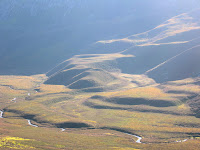
Glacial terraces Strath Nethy
All photos © Stewart Taylor


