Monday, 25 February 2013

Cairngorms National Park was created to make money!

Yes, the truth is out, the Cairngorms National Park Convener stated as much in a recent article in the local Badenoch and Strathspey Herald newspaper. According to the details listed on the National Parks website - http://www.nationalparks.gov.uk/learningabout/whatisanationalpark.htm , National Parks (and there are more than 100,000 worldwide) are protected areas and there is one organisation called the International Union for Conservation of Nature (IUCN) that helps to look after these protected areas globally. Their definition of a protected area is “A clearly defined geographical space, recognised, dedicated and managed, through legal or other effective means, to achieve the long-term conservation of nature with associated ecosystem services and cultural values”. I was therefore, quite taken aback when I read the Park Conveners article “Park Talk” on the 10th January. The first sentence that amazed me stated “The uncompromising
conservation message of recent decades is not what is important to most people”. This was followed a couple of paragraphs later with “So if we want our national parks to be influential we talk less about the loss of nature and much more about the love and wonder of nature; more about how we need the landscapes and wildlife to put hard cash into the pockets of businesses large and small”. This general theme was also given by our local MSP Fergus Ewing when asked about the general thrust of the article stating “The objectives (for the Scottish National Parks) include, put simply, conservation and recreation and social and economic development” but “in the event that there is a conflict that cannot be resolved then the first named objective takes precedence” however “I was anxious that the aim of considering the interests of the local residents may not be fully taken into account, if the first named principle and objective were to be preferred”. So, plans for 1500 new houses in Aviemore, 200 in Carrbridge, 40 in Nethybridge, a doubling of the size of Kingussie, a go-kart track outside the Aviemore permitted development boundary along with a neighbouring touring caravan site is what the Park – sorry Enterprise Company – is all about? Little of this is mentioned in a document, produced by the Park, out currently for public consultation (see http://cairngorms.co.uk/look-after/cairngorms-nature-action-plan1  Cairngorms Nature Action Plan) aimed at “protecting” what is important, in nature conservation terms within the Park. It took me a day to respond to the first draft and even with many critical comments about flowery writing and lack of honesty as to the state of our wader populations, woodlands and over managed grouse moors, all still seems to be hunky-dory in the second draft. Despite the wee bee Andrena marginata being singled out as a “key species for focused actions” the caravan site mentioned earlier will obliterate one of the few sites locally/nationally. Sadly, the folk charged with looking after something as important as the Cairngorms National Park have little real experience “out in the field” and it is left to the “uncompromising conservationists” in their own time and at their own expense to try and find out what is important in conservation terms at a proposed development site to inform those people making the final decisions. Enough, I’m starting to sound like a grumpy old man!

So, what has one of the uncompromising conservationists been up to this month? Interestingly enough the planning application for both the go-kart track and caravan site mentioned earlier came before the Cairngorm Park planners for approval or otherwise early in January with the outcome that both applications
be approved. However, at the planning meeting it became apparent that despite the Park, as one of several organisations brought together to initiate the Cairngorms Wildcat Survey (http://www.highlandtiger.com/cairngorms_wildcat_project.asp), it had failed to recognise that wildcats had been recorded within territorial distance of both applications and that the standard survey method of “camera trapping” had not been undertaken to prove presence or absence. Of all the species recorded by local natural history recorders, none of the species found carried the “European Protected Species” tag, and, because the wildcat could be present and European Law would be broken if it/they were disturbed, the developers have now to undertake a survey, using camera trap technology (static automatic cameras usually focused on a rabbit bait) to see whether these amazing animals are present. A visit
by myself to the proposed go-kart track site, in the snow, on the 26th did find cat tracks, but whether these belonged to the real McCoy or a wide ranging domestic cat, I couldn’t tell. A couple of days later I was back on site standing in front of a BBC Scotland camera being interviewed by Jackie O’Brien about why the kart development might pose a problem for wildcats, an interview which took almost a month to make it to BBC Reporting Scotland. Sadly, my ten minutes of questioning was reduced to just one quote whilst more recent interviews had been filmed and added with the developer and a staff member from the Park.

Despite January being in the depths of winter a request for information by the Highland Biological Recording Group for interested folk to go and look for an APHID had been carried over from last winter. Of course
most folk are more aware of aphids being active during the summer months when they can be seen in huge numbers on roses and garden plants as well as many wild flowers, trees and shrubs. But this request was for one specific aphid, active only during the winter months – even, possibly, in the Highlands of Scotland. This hardy species is the large willow aphid (Tuberolachnus salignus) and is active from August through to February, with none having been found during the other five months of the year. See http://www.nhm.ac.uk/nature-online/life/insects-spiders/common-bugs/aphid-watch/index.html  for more information. It was thought to have been seen in Inverness-shire but without a 100% positive identification, so any finds would be new for the Highlands. I have to admit to having spent lots of time searching along the branches and twigs of willow trees and bushes without ever seeing one so it was a bit of a relief when an email arrived from Murdo to say that he had positively identified the aphid near Strathpeffer on 15
December. Despite this find though, I still find it hard not to walk past a willow bush without having a quick glance just in the hope of seeing this 5mm monster of the aphid world. On one “quick glance” I did though
manage to find something else which initially I thought to be a lichen (above left) but which eventually turned out to be a fungus. It was small, reddish, and growing up through the bark of a dead bit of willow still attached to a live tree. With a bit of help from expert Liz, I was lead towards a fungus called Perrotia flammea and when I checked the internet both fungus and spores (above left) matched the descriptions. The NBN map showed the main distribution to be close to where Liz lives on Deeside, Aberdeenshire and with just one of the thirty-five known records occurring outside Scotland, the most recent record being from 2005. So, the first new record for Abernethy Forest in 2013.

The month saw a bit of snow clearing but none of the falls amounted to more than a few inches. Perhaps more remarkable was the unseasonal temperatures at the start of the month with Cairngorm making the
news with a temperature of 13 degs C! The visits to the local aspen woods continued in search of the Caloplaca lichen mentioned last month but though that lichen has yet to be found at a new site several woods have produced new locations for another rare lichen Schismatomma graphidiodes (right). To ensure I had the full details, a couple of samples were checked to see the amazing spiral of spores held in the “asci”, a
sac-like structure which holds the spores before they are ejected into the wider world. By taking a very thin cross-section sliver of the lichen and gently squashing on a glass slide with a touch of water, it is was
possible to see the asci and spores held within the lichen and also some that were “ejected” (above left) due to the squashing. Getting thin slivers from the thallus of the lichen which is itself just a millimetre or so in size is quite a good test, but, the thinner the sliver, the better the view under the microscope, particularly at x1000. Slightly less common has been the tiny pinhead lichen Sclerophora pallida, but provided a few trees have the areas of decay so common on some aspens, the pinhead can usually be found. A visit to a group of aspens near the Dorback Burn held a pleasant surprise with Sclerophora pallida (above right) growing in abundance in
an area of rot at the base of the tree and its close relative S. peronalla growing on the adjacent moss circling the base of the tree. Both species are so similar that a chemical test is needed to separate the two species. A wee touch of diluted potassium hydroxide, known as K in the lichen world, is applied to the fertile head of the lichen and if you get a purple reaction (including occasionally the formation of crystals), S. pallida is the species. Under the microscope the spores of S. pallida have tiny warts (ornamentations, see round objects photo above left) whereas the spores of its close relative are smooth and slightly smaller by a whole 2-3 thousandths of a millimetre (microns)!

The geese locally have been making the most of the residue of some farm fields that were poorly harvested, leaving lots of cereal heads scattered around the fields. Hundreds of rooks and jackdaws have also been
feeding in the same fields making for spectacular sights when all the birds get disturbed and take off together. In the local fields the geese have been mainly greylags but a few pinkfeet can be heard in some areas and have been heard flying by overhead. The first singing dippers were also heard mid-month and in the wider area both pied and grey wagtails have returned to breed. A visit to the Ryvoan Pass area of Glenmore to seek out more ancient goat willows found capercaillie droppings within a few hundred metres of the track, something that would surprise many folk walking the track, some probably hoping to see the illusive bird. Walking up one of the wee runnels a strange moss caught my eye (left), a bonny, leafy species which I knew
belonged to the Fissidens group, so more work once I got home. The easiest way I find to deal with mosses is to check the leaf under the low powered microscope and make an accurate sketch of what I see, complete with measurements. The leaf had small teeth at the tip and a sort of secondary leaf half-way along the main leaf and, thankfully, a single stalk (seta) with capsule was also present. The book, ‘Mosses and Liverworts of Britain’ is ideal to get you pretty close to species but regularly you really do also need ‘The Moss Flora of Britain and Ireland’ by Smith to see finer leaf details (cell sizes etc). The books lead me to the Maidenhair Pocket-moss (Fissidens adianthoides), a fairly common species but one that was new to me.

Two talks in Grantown on Spey early in the month tested out the grey cells in remembering all the species and additional information within the power-point presentations. Lancashire (with new turbines) also featured quite a bit during the month with visits to Janet’s mum who had a spell in hospital following a fall, but with good progress to
report by months end. Frantic emails towards the end of December put the finishing touches to my write up paper covering my five years of tooth fungi (stipitate hydnoids) surveys in Abernethy for ‘Field Mycology’. Thanks to the editors and a few people who helped with the developing drafts, the paper made it to Volume 14 which arrived with members of the British Mycological Society late in the month. You can see the article at: http://www.sciencedirect.com/science/journal/14681641/14 click on Volume 14 Issue 1, then scroll down to item 6 and click on the PDF file. A great end to all the field work.

That’s it for another month, enjoy the read.

Stewart and Janet


Still finding green shield-mosses


Green elfcup fungus


Sunset Nethybridge Old Kirk


Photos © Stewart Taylor

Thursday, 24 January 2013

Re-visit aspen trees in Caloplaca search

The end of December a year ago was a time of great secrecy before a night of celebration, and as the newspapers hit the shops with details of this year’s New Years Honours recipients, I was all so aware of the excited phone calls that would be bouncing around the UK and further afield as those honoured made contact with friends and family. Sir Wiggo claimed top spot on most of this year’s media front pages whilst the list of those honoured for “just doing what they do” covered a few pages inside. It was quite humbling to see those ordinary and famous folk being awarded the MBE bringing home the enormity of being listed as one of those honoured just a year ago. What an exciting summer all those recipients have ahead of them as they await the details of when and where they will receive their awards. Well done to all.

At the start of December the Highland Biological Recording Group held their AGM in Strathpeffer, and despite the threat of snow (see Ben Wyvis on the day left) the journey was made and fellow members met and chatted with. It was great to meet up with Brian and Sandy Coppins again and very timely that a couple of recent lichen finds could at last be correctly identified. After the business part of the meeting Prof. Bruce Ing gave an excellent talk on those
strange “growths”, slime moulds! See
http://www.buteman.co.uk/news/local-headlines/fungus-experts-pay-survey-visit-to-bute-1-2527559  for a little more information on Bruce. Bruce left an open offer to send any fruiting slime moulds to him for identification so watch this space as the new growing season gets underway. Before heading off to the meeting I helped Janet set up her stall at the last Farmers Market of the year, also managing to get back in time for the dismantling session. Once all the sales goods were back home, Janet set up a “wee shop” in the Firwood chalet in the hope of attracting a little passing trade in the run up to Christmas, a successful initiative before the chalet was returned to normal for an influx of family
members for the Christmas break. A few days later the overnight temperature dropped to -10 degrees C but by early morning had risen to zero. The lower temperatures though did bring the first lying snow of the winter and a morning spent looking after grandson Archie allowed Grandad to try his hand at creating a snowman and before too long something resembling a snowman was constructed, complete with pieces of coal for eyes and a carrot for the nose. A more difficult task was chipping away the frozen snow on the track to the house to allow the steep incline from the road to be negotiated safely. Brrr!

Mid-month was Christmas tree time and a search under a couple of power-line way-leaves on RSPB land provided something suitable, the first “real” tree we have had for a couple of years now being the proud owner of one of those artificial jobs. However, with a big family gathering due over Christmas, the real thing was needed in one room with the artificial job in another and by next day both were installed and made resplendent with lights and
decorations. Around the same time, 13-15th December, was also meteorite time with the Geminids shower reaching its peak. With heavy cloud on 13th and 14th it wasn’t until the 15th that there was any chance of watching the night sky, and even then, it was between bouts of cloud. The part of sky to watch was facing east, find (PHOTO left, Taken by Dennis Sharrod © on Dec 14 2012 in America facing due east at 01.29am) Orion’s “belt”, and watch the general area to the left of the “belt”. At 10pm I wandered up the road and within five minutes saw my first streak of light as a small meteorite was just about visible. Over the next fifteen minutes three small and two large meteorites were seen and just as I thought it was time to get the camera set up, in rolled
the next batch of cloud, and that was that. You can see a few photos at http://www.weather.com/news/geminid-meteor-shower-20121214 . A celestial event though was captured on Christmas Eve when a check of the sky in the early evening showed an almost full moon, high up in the sky, surrounded by a bright halo. After a few attempts at a long exposure with no halo to be seen in the photos a shorter, six-seconds one did the trick and the halo finally appeared. Also captured in the photo is Jupiter, seen to the left of the moon and within the halo. Halo’s around the moon are a sign of thin cirrus clouds drifting high above our heads and supposed to be an indication of nearby storms. None materialised.

With the end of the year bearing down during the month there was a big push to sort out my last few records and enter all the details into my copy of a biological recording database called MapMate (http://www.mapmate.co.uk/ ). During the year many hours were spent undertaking this task as many
records have their own unique location requiring quite a bit of time to create new sites as well as enter all the relevant data (see entry left). 2522 records were entered, from a single record of the wee mite Acalitus longisetosus found on birch leaves through to six records of Zygaena filipendulae, the six-spot burnet moth. Once entered, the records can be sent as synchronisation files to other users so that all data can be added directly to another users database. My database currently holds nearly 99,000 records, comprising mainly RSPB Abernethy records. Why spend all this time entering my data? To me it seems pointless wandering the country recording species if details of each record just sits in my notebook or PC. All the RSPB Abernethy records were sent to the reserve, all the lichen records to the British Lichen Society, dragonflies to the British Dragonfly Society and the whole set of records for the North of Scotland to the Highland Biological
Recording Group. Most records then find their way to the National Biodiversity Network Gateway (NBN) so that they can be displayed as dots on maps (see http://data.nbn.org.uk/interactive/map.jsp?srchSp=NBNSYS0000019311  for records of Lobaria pulmonaria for instance). By clicking into the map with your mouse you can zoom in on your area of interest (left click, hold and draw box) where you can then see the records in more detail. Consulting these maps lets you know if your record could be new to the area where you found it – a great system. Try it for Vulpicida pinastri right. All my records are entered onto NBN by species experts so a check is made on whether a species I have recorded is likely/expected from the area in which it was found. If not, the expert will query the record with me before adding it to NBN.

So, what was I looking for during December? Meeting up with Brian Coppins set me off on a single species search, whilst recording other things along the way. During a major survey of aspen wood lichens in Strathspey in 2001, he found a lichen on the bark of some trees in one of the woods visited, which, in UK terms, was quite rare, and so impressive was the population of Caloplaca flavorubescens (left) it was classed as
the biggest in the UK. That wood happened to be in Abernethy Forest and despite having visited the wood, I didn’t know quite what the lichen looked like and may or may not have seen it. The Caloplaca group of lichens contains many species that look very similar and on my visit I was very new to lichen identification and didn’t, at the time, have the where-with-all to check microscopically, difficult species being encountered. Following on from the 2001 survey, Brian had also found a second, even bigger population on a group of aspens on Rothiemurchus Estate, and when he asked if I had been seeing anymore during my own aspen wood visits, I had to admit that I wasn’t sure what I should be looking for. To help rectify this I was given the location of the second aspen wood and after a brief visit, knew exactly what to look for, though care would be needed as another very common lichen, Xanthoria parientina, also grew on the same trees! The first place to visit
would be the group of about 20 mature aspens in Abernethy and with the offer of a lift from Richard, to save time, I headed out at the first opportunity. This group of trees, about half a mile from the nearest track, are hugely important in UK terms but the sad thing is that some are nearing the end of their lives, and in recent winter snows, five of the twenty trees have fallen over. During the 2001 survey two lichens were found that were new to the UK, plus three Red Data Book species and eleven nationally scarce species. It was here that I first saw the script lichen, Schismatomma graphidiodes, one of the RDB species, and since seeing it here I have gone on to find it in many more aspen woods. On my way to the aspens I passed through several stands of juniper bushes and, casually checking them for galls I saw what I thought was the more compact of two similar species growing in needles on the tips of stems (left). I was correct, and it turned out to be a first for Abernethy -

Oligotrophus panteli – sorry about the name! I just love the approach to this group of aspens, nothing visible until you reach a steep slope and then suddenly, there they are, all branches pointing skywards (above right). Sadly, since my last visit three more trees are now on their sides and as I checked the first one I needn’t have worried about finding Caloplaca flavorubescens, it was everywhere, on tree trunks, on branches and even on dead branches. The Rothiemurchus site might have more individual trees with the lichen but I feel sure the Abernethy site has more, bigger, well established lichens. And what was the other lichen in great profusion (right) – Pannaria rubiginosa, a species I didn’t remember from my earlier visit (though my notebook told me differently), the biggest reserve population of
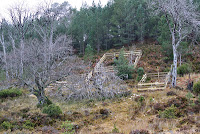
this rare Abernethy lichen. A very positive surprise was seeing that reserve staff had been busy and several deer exclosures had been erected in and around some of the aspens. Originally, when this proposal was put forward to the Forestry Commission and Scottish Natural Heritage, they were unhappy with the suggestion of fencing off the trees to allow natural regeneration (from suckers growing from the established trees roots) because of the possibility of bird strikes, particularly capercaillie and black grouse, so the compromise was the series of smaller, wooden exclosures (left). The height of the wooden fences was three to four feet and the size of each plot was such that deer would be reluctant to jump into them, so, thankfully, protection at last.
However, the need to get new trees established is urgent and I have suggested that a few young trees, currently growing in the reserves tree nursery and originating from this aspen stand, be planted. A great visit, and with daylight fading it was time to set off on the couple of miles back to the car. A bonus was a group of 8 waxwings feeding on berries in a patch of juniper. Brilliant.

The Christmas family gathering started on the 21st with the arrival of John and Jill, perfectly timed as I had just finished the last diary. Visits to say hello to daughters Laura and Ruth were made before Peter, Paula, Abbie and Lucy arrived on 24th. Present opening on Christmas Day was delayed until Ruth, Lewis and the boys arrived and with a super afternoon dinner expertly prepared by Janet, we ate and drank and talked well into the evening. Unlike the south of the UK, the weather locally
over the Christmas break was very kind and as Janet and myself dropped everyone off in Glenmore on Boxing day to walk back over the tops to Forest Lodge, the frost was keen but the sun was out and the hills and mountains looked stunning with their covering of snow. On the way back from Forest Lodge there was just time to show brothers John and Peter a log with about ten, well grown green shield-moss capsules with a promise from Pete that he would try to be the first person to find the moss south of the Scottish border. I await the phone call! As everyone headed back south again I had to thank Janet for her expertise in organising the Taylor’s Xmas gathering 2012 (right). Amazing and brilliant!

In between times a talk was prepared for delivery on 3 January, and the wander back through many of my previously visited aspen woods has so far failed to find any new sites for the Caloplaca lichen – but the search goes on.

That’s it for another month. A few of the highlight of 2012 follow below.
Sorry for the delay in producing this diary, there has been a problem with the Google blog-site
Happy New Year.

Stewart and Janet


Celestial happenings early in the year


Iceland Gulls Aviemore and Uists


Taphrina padi and all the galls and fungi


MBE – beat that!


Olympics – gold post-boxes


South Uist sunset


Photos © Stewart Taylor unless stated otherwise


Friday, 21 December 2012

Bennachie Weekend

First weekend in November, it must be the Haddo Christmas Fair, organised by the National Trust for Scotland. The run up to this two-day event started for Janet just after the summer holidays, with her little sewing machine working all hours to ensure there was enough tweedcrafts to keep her stall well stocked for the duration of the weekend. So, on the 2nd, and with the car filled to the gunnels, we headed over to the agricultural heartland of Aberdeenshire, stopping off at daughter Laura’s for lunch along the way. This craft fair attracts artisans from across Scotland and there were greetings from a few regulars as we parked by the
Haddo House theatre to unpack and set up the stall in readiness for the 10-o-clock start on Saturday. Duty done, it was back to Laura’s for the night and to Michelin star fare expertly prepared by Douglas. Once again the fair hit a weekend of frosty weather with brilliantly sunny days and once Janet and Laura were happy that the stall was ready for the hoards it was time for me to say cheerio and head off into the surrounding countryside. The wee bit of searching of family background covered in the October diary linked to Granny Ross had lead me, via her birth certificate, to her place of birth, Balbithan on the outskirts of Kintore, not that far from Haddo
House. Being in the general area and knowing that Kintore was on the way to Bennachie/Mither Tap where I had planned my day out, I thought it would be interesting to see whether the farmhouse of West Balbithan still survived. According to the current OS map it did and was located at the end of a track leading to East and West Balbithan and sure enough, when I drove along the minor road towards Kintore, an old signpost by the road pointed the way to the two houses. I parked the car in a layby at the end of the track and decided to walk to the house intending to politely enquire from anyone in residence whether I had found the right house. East Balbithan was modernised but generally as it would have been in Granny’s time. Passing a group of farm buildings (Granny’s parents were farmers) West Balbithan started to appear, but the old farmhouse was
now a group of buildings comprising several let properties, with several more modern buildings in the immediate area. Knocking on a few doors produced no response so I took a few photos before following the track back to the car. My Granny moved over to Deeside when she married whilst other members of her immediate family remained in the farming community close to Kintore. Life could have been very different if she hadn’t made that move all those years ago. The hill that dominates the Aberdeenshire landscape was visible in the distance – time to head in that direction.

The Forestry Commission car park at the start of the path to Bennachie was busy as usual, and not having climbed many hills in recent months the stroll upwards would be quite interesting, particularly as the reason for avoiding the hills was knee and hip protection. The hill though looked inviting and I was interested to see
if there were any unusual plants or lichens around the summit rock outcrop at just over the 500 metres contour. Either side of the track a massive forestry thinning operation had recently taken place. Although heaps of brash and stumps looked quite a mess if the removal of the spruces was to allow natural woodland to develop in its place, that would be a good thing, allowing a lot more light into the wood and track heading up the hill. The climb is quite easy really with the biggest test the repaired path up the steepest sections where pitching had created a series of “steps”, a good test for the thighs! Close to the top I cut off to the right and went to check another rock outcrop where cloudberry (Rubus chamaemorus) and fir clubmoss (Huperzia selago) were growing along with the usual mix of rock lichens. Approaching the top of Mither Tap (as the main summit of the Bennachie group is called) from the “back” leads you to a sheer face of rock but with a small amount of scree below, just the sort of place to have a root around. Hanging from the rock faces and in
small patches on the ground was the hair-like lichen Bryoria fuscescens and in other places a tight, spiky ball type lichen Cetraria muricata. Just time for a summit photo (above right) before heading off back to Haddo in time for the close of the first day of the Fair. Day two was again very frosty and the car park at Haddo was, in places, a bit like a skating rink. Just time for a helping hand to remove the covers from the stall before heading off to spend the day in the grounds of Haddo House. Previous visits had turned up many galls associated with oak and beech, so the targets today would be a tiny fungus growing on fallen beech mast (nuts, above left) and wee growths actually on the lichens on tree branches and twigs which are known as Lichenicolous fungi (non-lichenised fungi growing on lichens, all very complex, too much to try and describe here.). Wandering along one of the lesser used tracks lots of elder bushes were present, all with twigs covered in lichens but
none had been parasitised by the non-lichenised fungi, however in the woodland beyond I could see several huge, ancient beech trees which looked interesting. A bit of rooting around amongst the fallen leaves and beech mast and I quickly found what I was looking for; a beech mast with several small, white fungi growing from it. More rooting around produced several more, the tiny fungus going by the name of Hymenoscyphus fagineus. Leaving the beech tree and heading for a group of mature oaks I came upon several sapling ash trees and the twigs immediately caught my eye as they were covered in the right sort of lichens for the non-lichenised fungi. And sure enough there were a few groups of tiny red dots growing on what I call a spiky lichen (above right), one with long hair-like structures at the end of each lobe known as cilia. This lichen was Physcia tenella, a common lichen, and one of the main species to be regularly parasitised by a brilliantly named growth called Illosporiopsis christiansenii. Despite having found Illosporiopsis all over the place close to Nethybridge this appeared to be the first time it had
been recorded in Aberdeenshire. To show just how overlooked it was I also found some growing on lichens on a nearby beech twig. The amazing spiral spores of I. christiansenii are shown left.  By early afternoon the temperature had dropped and the frost was setting in. As I started to make my way back towards the big house I flushed a buzzard from the base of a wall running parallel to a small burn and immediately I could see the bird had something wrong with it as it almost ended up in the water. Slowly, I walked up to it and it was so weak that there was little resistance as I bent down to pick it up. There was no food in its crop and the bird’s breast-bone was sticking out like the bow of a ship, it had obviously not eaten for quite a while. Thankfully I always carry a black bin-liner for occasions like this, though quite often they are used to bag dead birds of prey. The buzzard was carefully wrapped so that it could be carried back to the car without attracting any attention. Back at the car the bagged buzzard was left as comfortable as possible in the passenger foot-well before I returned to the craft fair just in time to mingle with the last of the visitors ahead of packing up the stall. Back at Laura’s the shattered sales team
were able to relax over a cuppa whilst I went out to check on the buzzard, but the bird, sadly, had died. Arriving back in Nethybridge the following day I had just got into the house when the phone rang to ask if I could attend a meeting with a registered osteopath in Inverness as part of the insurance claim following our car crash OVER A YEAR AGO! No wonder our insurance premiums are so expensive. Perfect timing as the buzzard could be delivered to the Scottish Agricultural College vets to see why the bird had died, and a few weeks later it was revealed that a form of pneumonia was the cause.

A few days in the first half of the month were spent checking local oak stands to see what galls were visible before the leaves parted company with the trees. No more knopper galls were found but in some of the stands foraging jays were present. Checking amongst the fallen leaves for galls I encountered a few spindly,
tiny fragile fungi belonging to the group called Mycena, growing from the main veins on some leaves. Time to put my training with Liz last month to the test. This wouldn’t be too easy without the fungal identification books which I have yet to buy, but on the internet there is a brilliant guide called A Key to the Mycenas of Norway, (http://home.online.no/~araronse/Mycenakey/list.htm ) describing 120 species, with photos and microscopic descriptions. The laborious bit is having to check each of the species individually, but eventually you can narrow the identification down to one or two species. Then the tricky work is needed to carefully slice out one of the tiny gills, and then if that wasn’t enough, the gill then has to be cut into tiny slivers before squashing a couple of the slivers on a glass slide and checking under the microscope. A couple of hours later the fungus turned out to be Mycena smithiana with the view down the microscope producing amazing
views of tiny spores all of which had a ‘punk hair-style’ sets of projections from the broad-end of each spore. Click on Mycena smithiana on the above website to see what I mean and just about visible in the attached photo (right). Brilliant!

The winter thrushes have mostly now headed south and all around we now have fields full of grazing geese, mainly greylags. Few reports, as yet, of the unusual geese that appeared last year, white-fronted and bean. A local green woodpecker is very unusual and if the weather remains reasonably kind perhaps we will see a repeat of the breeding which occurred during the 1980s. The local tawny owls have been calling, setting up their territories for 2013 and with the shortest day upon us, I can’t wait for the lighter days of spring. One bird that has been quite regular during November has been the waxwing, with 20-30 in most of the groups I was lucky enough to encounter whilst looking for galls and lichens. Most birds were found finishing off the
last of the rowan berries (top of tree left) and at a couple of sites, much rarer hawthorn berries. It was great to hear their tinkling bell-like calls as I wandered from tree to tree in local aspen woods looking for the beautiful but rare script lichen Schismatomma graphidioides. In one aspen wood thirty plus trees have been found with the lichen and considering just a tiny bit of the wood has been surveyed, this could turn out to be quite an important site in UK terms for this species. Several other rare lichens have already been recorded in this wood during a short survey in 2001 – so it is turning out to be a very special piece of woodland indeed. Another bit of woodland that has been saying “come and visit me” is a tiny sliver of mainly birches running away from the A9 Perth to Inverness road just to the west of Slochd Summit, clearly identifiable to those
travelling north by the phone mast perched on the highest bit of the hill. A few nice things were recorded and, because I left it late to make my visit, I will have to return again one day. As I climbed out of the gulley, close to the mast it was getting quite late and with darkness falling I had to make a quick call to Janet to let her know I was still alive! Knowing there was a track leading from the phone mast back to the road I headed towards it and was pleasantly surprised by the sight of rows of lights from vehicles thundering below me on the A9. Perfect, and just time for a long exposure photograph before heading back down the icy track to the car. If you go down in the woods today, do keep an eye open for strange growths on the tips of new growth on Norway and Sitka spruces. A morning walk with grandson Archie took us up through the spruces on Forestry Commission
land above Insh Marshes, and whilst Archie used his stick to attack the dead stems of bracken, I noticed several slightly bulbous growths on the tips of several Sitka spruce branches, so I popped a couple into a tub for checking once I got home. Under the low-power microscope I cut one of the growths in half and was amazed by what I found (left), more than a dozen empty galleries which during the summer would have been full of aphids. The aphids belong to the family Adelgidae and the gall is known as Adelges cooleyi. Thanks Archie.

That’s it for another month.
Have a very Happy Christmas and best wishes for 2013.
Stewart and Janet


Happy Christmas


Somewhere over the rainbow – with Archie


Sorting out the Christmas card!


Bennachie sunset


Photos © Stewart Taylor