Sunday, 21 April 2013

Archie’s Grimmia find at Ruthven Barracks

I suppose the good thing in this part of the world during the latter part of March was that we missed the falls of drifting snow experienced elsewhere in the UK, somewhat weird being in a notorious part of the country for snow, and, thankfully, not getting much. We weren’t though immune from the cold easterlies that prevailed for the second half of the month and even with some sunny days at the end of the month, extra layers were needed when out looking for things. The lowest temperature was on the 31st at -11 degrees C.  See River Nethy ice sculpture.
The last two days were exceptional for sun with the bright sphere rising at dawn and not disappearing until official sunset time. Whilst all the wind-farms locally hardly turned a blade in the still, cold weather, the PV panels on the roof produced 20 kilowatts of power each day! Interestingly in the last week of March last year we were basking in 20+ degrees C of warm sunshine, the earliest records locally for several moths and butterflies were made and I even had a dragonfly whizz through the garden! The last week of the month also saw Janet and myself house-bound as we took on the role of “real” grandparents, looking after Archie whilst brother Finlay travelled between doctors and hospital with a severe chest infection. We are now both expert Lego builders, it would be useful though if the suppliers included a few more of those fiddly little pieces that take the place of indicators on the corners of the cars!

With daughter Ruth now living in Insh, close to the RSPB Insh Marsh Reserve, walks from her house quite often lead us onto the reserve and in particular, through the amazing stands of mature aspen trees. An outing in 2010 with Brian and Sandy Coppins to these aspens was my first real experience of aspen lichens – they

were there surveying the trees to identify those most important for their lichen populations (see Firwood Diary February 2010) to aid future management. In passing, I have looked at a few of the trees found in 2010 to see what has happened to some of the rare lichens, and to be able to monitor any major changes accurately rather than just visually , I thought it would be best to repeat my close up photographs taken in 2010. One of the rarest locally is the “eagle claw lichen” (Anaptychia ciliaris) still only known from just the one tree at Insh – despite much personal searching in the wider area – and the repeat photo showed that very little had changed over three years. The other rarity was Collema nigrescens, again, only found on a single tree at Insh – its only known location within Strathspey – and here the repeat photo showed that quite

a bit had changed, (top photo 2010, bottom photo 2013) with a loss of a fair percentage of the lichen over three years. This lichen is growing low down on the main stem of the tree and is probably vulnerable to damage from passing mammals. This tree along with its near neighbours comprises a group of aspens with probably the biggest populations of rare lichens in the area. Many of the trees have canker damage and some are in the early stages of dying, two conditions which seem to be ideal for the bonny wee pinhead Sclerophora pallida. Bits of detached bark lying on the ground by a couple of the populated trees contained more pinheads (100’s) than can be found on many of the other whole trees with the lichen within the Strath! This lichen also appears in the February 2010 Diary.

One recent outing involved a walk through Insh village and on to Ruthven Barracks, with grandson Archie in charge of the camera for part of the time. A photo of me by the local footpath sign was achieved after excellent shots of my feet, my legs and the pine needles on the track! Spiders were searched for under fallen
logs and plant galls were found on juniper and willow bushes and an amazing ‘find’ of a kitkat by the track allowed for sustenance along the way. On the way to Ruthven Barracks whooper swans were spied on the marshes and curlews were heard despite the cold day. The now resident greylag geese were also feeding in many roadside fields. The sun was out tempting buzzards to display overhead and a few fieldfares were seen searching for food in fields with local mistle thrushes. At Ruthven Barracks the builders had completed their repairs and the scaffolding which had been protruding from various bits of the barracks had now been removed. Archie managed to visit most accessible bits of the building accompanied overhead by a noisy gang of jackdaws. We made our way back round the sunny, outside of the main building, but still chilled to the bone by the easterly wind. “Whatzat” asked Archie pointing at a nicely hairy grey/green moss on the wall, but apart from confirming “a moss” I didn’t have a name, so in order to possibly rectify that Archie took a photo along with one of a single daisy flowering in the grass. It was only when I downloaded the pictures that I realised the
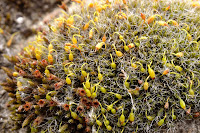
moss was quite distinctive and it might be possible to give it a name and sure enough, as I worked my way through the Mosses and Liverworts handbook, distinctive grey leaf hairs along with capsules bending back into the cushion lead me to the grey-cushioned grimmia (Grimmia pulvinata). Despite this being our commonest British Grimmia, there wasn’t a dot on the NBN Gateway map for the 1 km square for the Barracks so well spotted Archie. I have seen the moss since on stones of a couple of bridges so it is one you shouldn’t have too much trouble finding.

I have photos but not the specimen. This was the reply I had to give to a query about the wee Mycena smithiana fungus I found on oak leaves in November 2012 and as featured in the Firwood December Diary. I hadn’t really checked the status of the fungus in Scotland when I made my identification (as found
and via microscope) but out of 83 records currently on the GB fungal website, only 3 are from Scotland, 2 of which are classed a doubtful –oops! Eventually my record was accepted due to all the features being correct via the reasonable quality of the photos but there is now a date in the diary for a new search in November and if found, a specimen will be retained and sent to the experts – lesson learnt. A visit to an area on the edge of Kingussie to collate records of species for an area designated for 300 houses , yes, 300!, took me through an area of Scots pine to check for the presence of red squirrels. Whilst watching the ground for predated pine cones I noticed a pale, non-descript fungus emerging from the ground. Suspicious, I poked my finger into the pine needles and humus below the fungus and felt the substrate the fungus was growing from – a buried pine cone (above left). This is a normal looking “gill” fungus, not the other “toothed” type also regularly found on pine cones, and goes by the name of Strobilurus tenacellus. Not a species to stop houses being built and nothing else was found of national importance so the Planners will need to consider the lack of proper surveys for birds, invertebrates and mammals and the impact to the wider area, particularly the designated habitats, reserves etc. On the way home I wandered down to an area I had never been to before despite its importance for flowers and insects, particularly butterflies – the confluence of the
Rivers Feshie and Spey (left). This area is a mass of sand, rocks and gravels mainly washed down the River Feshie, some areas very stable and vegetated and others still in a state of mobility, maintained by the two rivers delivering huge quantities of water in times of spate. This alluvial fan covers quite a big area as sections have been re-worked by the rivers over millennia and in the couple of hours available only part of the area was visited. I did though have a target species – Peltigera leucophlebia – a lichen I have occasionally found in this type of riverine habitat. My regular first flower of spring was popping up from the gravels, the bright yellow petals of coltsfoot, the flowers appearing well ahead of the leaves. Old stems of bird’s-foot trefoil and scabious gave some indication of the potential species richness later in the year. This was obviously going to be a day for Peltigera lichens with the diminutive P. didactyla the first followed by (confirmed at home via a small
sample) P. polydactyla. The nicest sound of the visit was made by whooper swans flying by overhead. As I wandered back and forth across the gravels I was hoping that no-one was watching my slightly strange behaviour, but I was trying to ensure I visited most of the areas where it was obvious that an element of stability had occurred and vegetation had become established. Eventually I was wandering through areas of patchy tree regeneration when the green, “spotty” lobes of the target lichen Peltigera leaucophlebia were found (green spotty leaves above left), a single patch, about 30mm square. Time to head home. By the forest track I noticed several logs in a well rotted state so couldn’t help myself from having a quick look for the green shield-moss. No joy, but there was another
moss there with very strange stalks and capsules, all of which were doubling back on themselves burying the capsules in the leafy cushion of the moss. Having got home and checked the mosses handbook I have a note in my diary which reads “Of course it had to be the dwarf swan-neck moss” (Campylopus pyriformis)!


A notable event happened early in the month, Brian Coppins, who was on his way to the monthly meeting of the Inverness Botany Group, asked if it would be possible to stay for a couple of nights to allow time to look at the amazing aspen, hazel, elm wood near Grantown on Spey. So, on a sunny morning but with a covering of snow, we headed out, along with Bella his dog, to the woodland, the rising sun quickly melting lying snow. The first stop was for Brian to make a list of all the obvious lichen species readily visible in the same way that I would do something similar for birds, however, it would take a long time for me to produce the same lichen list, hence the reason for his visit. A hazel stem produced a

species of lichenicolous fungus in the Sphinctrina family and new species were added from the aspens, birches and willow. The ancient elms failed to produce the Gyalecta ulmi that I had hoped I hadn’t overlooked on my earlier visits but did produce Biatoridium monasteriense a rare species nationally (see map). Ninety nine species were identified by Brian on the day with other species taken away for further work. A fallen aspen also produced another location for the wee twig fungus Encoelia fascicularis with Brian also finding it below the tree on detached twigs lying on the ground. I did say to watch this space! In the evening Brian had a look at several specimens of the dark, crust lichens mentioned in last month’s diary and was pleasantly surprised to confirm that one of them was Fuscopannaria mediterranea, a new species for the Tulloch list. So, with so many “crusts” from such a small area, Tulloch was to be the destination for the half day outing the following day. On the way in to the main stand of aspens
to be checked Brian spotted a single specimen of Collema furfuraceum on one big aspen, another new species for the stand. In the area where I had found the “crusts” a few weeks earlier Brian was amazed to find F. mediterranea on many trees, the lichen displaying small patches of pale yellow/ochre in amongst blue-grey squamules, an identification feature I hadn’t known about (above left). A few aspens had huge populations of Degelia plumbea and the recesses at the base of one aspen revealled a small population of Collema occultatum, another new species. So, a brilliant couple of days, too many species for my wee brain to take in but with enough information to give me a few new species to look for. Interestingly, the area of aspens searched initially by me and re-visited with Brian is just a small part of an area of similar type woodland continuing beyond the boundary fence of the search area, so who knows what else there is yet to be found. With a part of an afternoon spare late in the month I was tempted back – just to venture over the fence. The aspens on the edge of the stand didn’t produce anything special but I remained faithful to my search method of systematically visiting all the trees as I worked my way from the edge of the field and into the wood proper and closer to the well endowed aspens on the other side of the fence. The first find was more of the aspen twig Encoelia fungus on two separate fallen branches. A leaning hazel (always more interesting than the
upright ones) didn’t disappoint and I could see as I approached that it had a big population of one of the crust lichens – Parmeliella triptophylla – one of the commoner crusts. On top of the crust was lots of Degelia plumbea and Pannaria conoplea and close by the two Nephroma’s, N. parile and N. laevigatum, all rare species locally. An adjacent hazel and the two closest aspens were also covered in D. plumbea creating perhaps the biggest population locally. What though was that popping out of the bark of the dead hazel twig? It was the spring hazel cup, Encoelia furfuracea! Intriguingly there was a large fallen aspen branch a couple of metres away and on the twigs were the fruiting bodies of its close relative Encoelia fascicularis! This is probably the first time in the UK that the two species have been found growing side by side (above left). Amazing! To round off the amazing couple of hours a green woodpecker was also calling.

The month was drawn to a close with a talk to the Highland Branch of Butterfly Conservation and various envelopes were opened as all the recording forms for various summer surveys were sorted into ‘what to do and when’. Let’s hope that the weather warms up shortly, the first butterfly transect is due in the first week of April! Well, we all live in hope!

That’s it for another month, enjoy the read.

Stewart and Janet

Web links from the diary above.
Firwood Diary February 2010
http://firwoodcottage.blogspot.co.uk/2010/02/48-hours-of-absolute-mayhem.html
Ruthven Barracks
http://www.undiscoveredscotland.co.uk/kingussie/ruthvenbarracks/
For NBN Gateway see  http://data.nbn.org.uk/
Firwood Diary December 2012
http://firwoodcottage.blogspot.co.uk/2012_12_01_archive.html
Mosses Field Guide (BBS) for Dwarf swan-neck moss
http://www.bbsfieldguide.org.uk/sites/default/files/pdfs/mosses/Campylopus_pyriformis.pdf


Old Tutsan flower, a new find locally


Puss moth larval case


Colt's-foot, sign of spring?

Photos © Stewart Taylor

Saturday, 30 March 2013

Asteroid failed to appear unlike my aspen fungus

The 15th and 16th February provided two very different experiences. A break in the cloud and a frosty evening on the 15th tempted me up the road, complete with camera and big lense to see if I could see Asteroid 2012 DA14. An earlier phone call from Ruth and the boys informed me that they would be heading down the road towards Ruthven Barracks with the same intention because Finlay is very interested in the solar system. He reminded me in no uncertain terms that the sun was a star and not a planet! Silly Grandad! So, as we headed out to our two viewing sites we promised to phone if anything was seen. The
internet guidance was that the asteroid would pass through the stars making up the Plough, somewhere near where the handle joined the four stars forming the “pan”. The accuracy was such that an approximate time was given when this would take place, round about 9pm. So, with everything set up at 7.45pm I awaited the big event. Trial exposures of 2-3 minutes produced the usual patterns of star movements (left) even in that short time, and, because the asteroid would be travelling across the Plough in another direction to the star tracks, any bright object should be fairly obvious. 9pm came and went and still there was no obvious asteroid “track” and by 9.30pm it was becoming apparent that once again, the heavens had failed to play ball. So, with feet and hands loosing all feeling it was time to head home defeated. Ruth had more sense and realised early on that there was little chance of the boys standing around long enough to find a dull object through binoculars passing high over head, and had headed home to bed. Oh well, we might have better luck when it passes by again on 16 February 2046!

Despite frosty nights, day times mid-month were often quite sunny and the 16th dawned with lots of birds singing and the great-spotted woodpecker drumming away on its usual tree just down the road. On-going checks of aspen trees locally lead me to Tulloch where catkins appearing on hazel trees also hinted that
spring was on the horizon. A small section of aspen wood I was visiting had been surveyed in 2001 and 2002 by a group of lichen experts and I felt quite honoured to find a few new locations for some of the rarer species along with the occasional new species. A few fallen hazel branches had tell-tale signs of a strange fungus which makes itself known by causing the recently fallen branch to peel back its bark allowing the fruiting body to develop on the wood below. This fungus is readily identified by its waxy, slightly shiny appearance and is appropriately known as the waxy crust (Vuilleminia coryli). A very similar species grows in exactly the same way on oak branches. These fungi belong to a group known as “resupinates” meaning that the fruiting body of the fungus grows with its body lying flat on the substrate. It was “crusts” though of the lichen kind that started to make me feel that aspens in this section of woodland, not previously visited by experts, was a
little bit special. The nice bluish lobes of Pannaria conoplea was found quite regularly (left) along with the darker Parmeliella triptophylla with its tiny coral like growths (isidia) growing from lobe margins. I find this group of lichens quite difficult to identify correctly in the field so a few small samples were collected from the bigger populations for observing under the microscope once home. A month later one of the specimens collected was going to lead to a return visit, confirming that a new species had been added to the Tulloch aspen list. More about this next month. The trees in this area almost fall into the pasture-woodland category, the stand of aspens, birches and hazels being cut into by small areas of farm fields, no doubt converted from woodland a couple of centuries ago by our pioneering ancestors. On the edge of one field I could see the remains of a large birch tree which must have been removed after falling over, the smaller sections of the tree having been cut up for
firewood. Immediately, areas of the butt of the tree looked like green shield-moss territory, and sure enough, a group of 4 capsules grew proudly from the decaying log. Close by was a recently fallen aspen and, with all the usually high up smaller branches now at ground level, it was possibly to check for a Red Data lichen which was only re-discovered in the UK in 2001, Lecanora populicola. This lichen only grows on bark of the younger branches of aspens and is absent from the rougher bark of older sections of the trees, so anything recently fallen is always checked in passing. Even more unusual is a Red Data and UK Biodiversity Action Plan species of parasitic lichen going by the brilliant name of Candelariella superdistans, which is found growing on the Lecanora, but more about the two of these shortly. So, with so many young branches available I made my way over to the aspen. As I started to check the twigs something else caught my eye, a brown, cup-like fungus, pushing up through the bark (above left). My first thoughts were that the fungus looked very similar to the spring hazel-cup fungus (Encoelia furfuracea) I had been finding quite regularly last winter, but it definitely wasn’t that species. So, plenty of photos were taken along with a small section of twig complete with a few of the “cups” for checking later. Searching the rest of the branches failed to find the Lecanora, a pattern that is starting to develop when visiting various aspen woods. Some woods have the lichen whilst others have hardly any and this might have something to do with the aspen “clone” present in each wood. Most aspen reproduce asexually, ie via suckers from roots of existing trees, producing a stand of genetically
identical trees. The chemical make-up of the bark might be ideal in one aspen stand but not in another – who knows, but this phenomena seems to hold for some of the other scarce lichens. I digress. Loaded up with several crust lichen specimens and one fungus, I headed home to set up the microscopes. I was reasonably happy with the identification of most of the lichens though there were a couple of queries for expert Brian. The fungus was in good condition and allowed several very thin slices to be made for “squashing” to check under the microscope. Sac’s (asci) of 8 spores (left) were found with the spores slightly banana shaped. Not having any fungus identification handbooks I was now a bit stumped but thought I would try typing “fungus on populus tremula twigs” into Google and, amazingly, on the first page of options the FRDBI (Fungal Record Data of the British Isles) web-page was shown giving me a name of Encoelia fascicularis, and showing that there were only 39 records in the database, the last known one in Scotland being in the 1800s! Typing the name into Google Images showed I had the right fungus and this was confirmed a few days later by expert Liz. Brilliant but worrying that this was yet another species to go and look for! Two days later another small population of the fungus was found by the River Spey near Grantown on Spey – watch this space.

Early in the month myself, Ruth and the boys headed down to Lancashire at half-term to meet up with Janet who had been there for the first week and to spend a few days with Grandma Holden now that she was much better and out of hospital. Janet had found a suitable house to rent on the edge of Great Harwood just
a few miles from Grandma but also very handy for outings into the surrounding Ribble Valley. The picturesque village of Waddington was a perfect place for a bar lunch on the first day and a walk round the village allowed Finlay and Grandad to test out one of several sets of stepping-stones crossing the tiny stream running through the village. A nuthatch in the trees by the church was nice to hear. A late afternoon walk up the hill found a couple of galls on a roadside oak, but the main aim was to try and capture a photo of the surrounding landscape as the evening lights came on along roads, factories etc just as folk were making their way home from work. Grandma Holden was in good form for an outing to Slaidburn the next day though the wind and rain curtailed any village walk. The last day saw us visiting the Roman settlement of Bremetannacum, the modern
day village of Ribchester where a Roman fort was built to protect the location of the crossing of the River Ribble. It is thought that the fort was abandoned around the 2nd Century AD, but the remains of the main building have been excavated and the adjacent museum tells you all about the goings on all those years ago. Interestingly a friend of my fathers gave me a roman coin which supposedly was dug up by workmen involved in building houses in Ribchester around 1900.

The first week of February saw a few days where snow greeted the opening of the curtains in the morning allowing a bit of data entry catch up. A day out in the light covering of snow in the Kinchurdy area of Boat
of Garten was interesting as evidence of the presence of three of our regular mammals was found as I walked along the track towards the River Spey. Fox and pine marten tracks were scarce with just a few imprints but the badger I followed for several hundred metres along the main track left lots of obvious footprints as it shuffled from one side of the track to the other (left). A holidaying couple I met close to the estate fishing hut by the Spey went one better, having just seen an otter, down river and at close quarters.
Thankfully they were not intimidated by a strange man staring at aspen trees as they approached and were even interested enough to enquire what I was up to. The weather forecast was predicting more heavy snow on the 4th and 5th so on the Sunday I decided to make a long awaited return to a steep-sided burn close to the Highland Wildlife Zoo – sorry, Park! My first visit was way back in December 2009 when I was looking
for suitable sites for the green shield-moss when I happened to bump into several old goat willows with big populations of lungwort (Lobaria pulmonaria). With a bit more knowledge of mosses and lichens I was sure there were more unusual species still to be found. Leaves of primrose and wild strawberry indicated that the site was not too acidic and would probably warrant a summer visit to see which other flowers might be present – provided the sheep and deer predation wasn’t too high. More willows were found to be supporting populations of lungwort and a couple of trees had small quantities of the rare lichen locally, Degelia plumbea (above left). Highlight of the day though had to be one of those tricky “crust” lichens, Fuscopannaria mediterranea, identified recently by Brian Coppins, growing on an ancient willow (above right). Saddest sight of the day
was the skull of a long dead capercaillie by a forestry fence, the fence just stock height, unmarked and a manmade artefact still doing damage to this huge forest grouse. Six inches of snow fell the next day! On-going surveys of local aspen stands continues and at one recently visited wood near Carrbridge I found perhaps one of the biggest aspens yet encountered. The tree was found late one afternoon as it was getting dark so I re-visited the next day to measure the tree and despite having lost half of its crown the diameter at breast height (DBH a standard way of measuring trees) was 84 centimetres. With lots of fresh branches close to the ground the tree was very suitable for looking for the Lecanoria mentioned earlier and possibly its wee parasitic friend Candelariella superdistans. Despite there being lots of young branches, only a few
looked suitable for the Lecanoria and several, thankfully, had the lichen present. Now for the difficult bit, finding a small yellow speck on the apothecia (fruiting bits) of the lichen. The only guide I had as to what I was looking for, was a photo I had taken of a group of lichens growing on a snapped branch in one of the Grantown on Spey woods. I hoped what I had photographed on that occasion was Lecanoria populicola so asked Brian for his expert opinion. Yes, most likely was his reply “but it also looks like you have photographed its parasite Candelariella superdistans, the 3 yellow apothecia on the far right”. So this is what I based my search on and as I worked from branch to branch I found what looked like the real thing, 4 yellow circular growths on one of the patches of the Lecanoria (in centre of photo right). This was confirmed recently, adding another dot to the atlas of distribution for this rare parasite.

In between times a new talk was prepared for the AGM of the Highland Branch of Butterfly Conservation in March, a red deer hind was skinned, hung and cut up for the freezer. The 27th saw a temperature difference on the day of 18 degrees centigrade, minus 9 to plus 9 between night and day leading to an over-dressed
outing on one of the warmest days of the year! Minus 12 degrees centigrade though was the lowest of the month. I also lost 20-14 to Finlay as he gets better at the backyard version of football! New lichens were also found for RSPB Insh Marshes (Sticta sylvatica) and RSPB Abernethy Forest (Leptogium saturnium). An amazing fact also arrived during the month regarding my recording database MapMate. Records passed between users via “replication” passed the 10 billion records mark since the system was created showing the huge amounts of data created and shared by MapMate users. Most of these records eventually get passed on to the National Biodiversity Network allowing the creation of the hugely informative distribution maps for many of the UK species. A red squirrel was also seen undertaking the impossible, getting into the top hole of the tall nest-box in the garden. The starlings that bred in the box last year are now probably aware of the threat and have so far not been seen near their old nest site.

Web links from the diary above.
For Bremetannacum / Ribchester see:
http://www.google.co.uk/search?q=bremetennacum&hl=en&sa=X&rlz=1R2AURU_en&tbm=isch&tbo=u&source=univ&ei=JvBSUaDfDuaW0QXw-oCAAw&ved=0CHAQsAQ&biw=1428&bih=617
For MapMate see:
http://www.mapmate.co.uk/  
For NBN Gateway see:
http://data.nbn.org.uk/

That’s it for another month, sorry for the delay which will be covered next month but do enjoy the read.

Stewart and Janet


Archie at Grandads special pinhead lichen tree


Snowy Cairngorms


Race to America


Photos © Stewart Taylor

Sunday, 3 March 2013

Safeguard the Cairngorms – can you help?

As you read in the last diary, the area designated the Cairngorms National Park is being threatened locally, by excessive development, particularly by massive housing developments, with applications in process for 1940 houses. On top of the direct loss of important habitat, the increased pressure on fragile mountain habitats and other designated areas, National Nature Reserves etc from an estimated additional 4000 people, their cars and pets in the Badenoch and Strathspey area alone, will be immense. Erosion on the shores of Loch Garten and Loch an Eilien is already beyond repair and there is nothing in the proposed development plans to mitigate against more damage to these and other sites.

The Park Board seem incapable of standing up for natural history interests of the area they have been tasked to look after so it has fallen on the shoulders of four bodies that feel passionately about the plants and animals living there to try and ensure future developments are sustainable and less damaging.

Sadly, the one body that would once have stood up for the natural heritage interests, Scottish Natural Heritage, has lost its teeth, with all the crucial decisions on anything less than that meeting “Protected European Status” being passed to the Park Board.

For the last 36 years I have tried my best to record the species and extol the values and importance of the natural history interest within what is now the National Park area and it is so sad to see our local area now being treated as an enterprise park. A few of the species that make the place important to me are included below, and some may be special to you so if you can support this appeal against over development that would be great.

If you love the area and its wildlife just as it is and can help with the legal appeal please go to http://www.safeguardthecairngorms.org.uk/ and donate online. Alternatively, use the details on the appeal literature copied below.

Stewart and Janet


Hydnellum cumulatum – a tooth fungus


Hydnellum gracilipes – a tooth fungus.
Both of these fungi were new to the UK when found recently in Abernethy Forest and both have yet to be found outside the Park area. Out of 19 currently known species of tooth fungi in the UK, 15 have been found in Abernethy Forest. The Scots pine woodland around Loch an Eilein is also important for these fungi.


Red squirrel


Farmland.
Farmland habitats within the Park are also important


Loss of waders.
However, many important farmland wader areas in the Badenoch and Strathspey area have been damaged or lost due to agricultural intensification. The Park Board would be better advised to work towards reversing this damage before allowing more habitats to be lost to the proposed developments.


Swallows.
Insect rich habitats are essential for annual breeding success for these summer visitors.


The Pine Hoverfly – Blera fallax.
Currently only found in Strathspey woodland within the UK.


Capercaillie.
 A female bird scurries along a track protecting its young brood. A bird that will suffer from disturbance as more folk seek out the quieter places for dog walking and recreation.


The Green Shield-moss – Buxbaumia viridis.
This rare Red Data moss has its UK stronghold in Strathspey.


Twinflower.
One of the iconic pinewood plants.


Sunset over Insh Marshes NNR.
The main breeding wader site within the Park and home to ancient aspen trees with rare lichen populations, some recent finds being new to the UK.

Photos © Stewart Taylor

Monday, 25 February 2013

Cairngorms National Park was created to make money!

Yes, the truth is out, the Cairngorms National Park Convener stated as much in a recent article in the local Badenoch and Strathspey Herald newspaper. According to the details listed on the National Parks website - http://www.nationalparks.gov.uk/learningabout/whatisanationalpark.htm , National Parks (and there are more than 100,000 worldwide) are protected areas and there is one organisation called the International Union for Conservation of Nature (IUCN) that helps to look after these protected areas globally. Their definition of a protected area is “A clearly defined geographical space, recognised, dedicated and managed, through legal or other effective means, to achieve the long-term conservation of nature with associated ecosystem services and cultural values”. I was therefore, quite taken aback when I read the Park Conveners article “Park Talk” on the 10th January. The first sentence that amazed me stated “The uncompromising
conservation message of recent decades is not what is important to most people”. This was followed a couple of paragraphs later with “So if we want our national parks to be influential we talk less about the loss of nature and much more about the love and wonder of nature; more about how we need the landscapes and wildlife to put hard cash into the pockets of businesses large and small”. This general theme was also given by our local MSP Fergus Ewing when asked about the general thrust of the article stating “The objectives (for the Scottish National Parks) include, put simply, conservation and recreation and social and economic development” but “in the event that there is a conflict that cannot be resolved then the first named objective takes precedence” however “I was anxious that the aim of considering the interests of the local residents may not be fully taken into account, if the first named principle and objective were to be preferred”. So, plans for 1500 new houses in Aviemore, 200 in Carrbridge, 40 in Nethybridge, a doubling of the size of Kingussie, a go-kart track outside the Aviemore permitted development boundary along with a neighbouring touring caravan site is what the Park – sorry Enterprise Company – is all about? Little of this is mentioned in a document, produced by the Park, out currently for public consultation (see http://cairngorms.co.uk/look-after/cairngorms-nature-action-plan1  Cairngorms Nature Action Plan) aimed at “protecting” what is important, in nature conservation terms within the Park. It took me a day to respond to the first draft and even with many critical comments about flowery writing and lack of honesty as to the state of our wader populations, woodlands and over managed grouse moors, all still seems to be hunky-dory in the second draft. Despite the wee bee Andrena marginata being singled out as a “key species for focused actions” the caravan site mentioned earlier will obliterate one of the few sites locally/nationally. Sadly, the folk charged with looking after something as important as the Cairngorms National Park have little real experience “out in the field” and it is left to the “uncompromising conservationists” in their own time and at their own expense to try and find out what is important in conservation terms at a proposed development site to inform those people making the final decisions. Enough, I’m starting to sound like a grumpy old man!

So, what has one of the uncompromising conservationists been up to this month? Interestingly enough the planning application for both the go-kart track and caravan site mentioned earlier came before the Cairngorm Park planners for approval or otherwise early in January with the outcome that both applications
be approved. However, at the planning meeting it became apparent that despite the Park, as one of several organisations brought together to initiate the Cairngorms Wildcat Survey (http://www.highlandtiger.com/cairngorms_wildcat_project.asp), it had failed to recognise that wildcats had been recorded within territorial distance of both applications and that the standard survey method of “camera trapping” had not been undertaken to prove presence or absence. Of all the species recorded by local natural history recorders, none of the species found carried the “European Protected Species” tag, and, because the wildcat could be present and European Law would be broken if it/they were disturbed, the developers have now to undertake a survey, using camera trap technology (static automatic cameras usually focused on a rabbit bait) to see whether these amazing animals are present. A visit
by myself to the proposed go-kart track site, in the snow, on the 26th did find cat tracks, but whether these belonged to the real McCoy or a wide ranging domestic cat, I couldn’t tell. A couple of days later I was back on site standing in front of a BBC Scotland camera being interviewed by Jackie O’Brien about why the kart development might pose a problem for wildcats, an interview which took almost a month to make it to BBC Reporting Scotland. Sadly, my ten minutes of questioning was reduced to just one quote whilst more recent interviews had been filmed and added with the developer and a staff member from the Park.

Despite January being in the depths of winter a request for information by the Highland Biological Recording Group for interested folk to go and look for an APHID had been carried over from last winter. Of course
most folk are more aware of aphids being active during the summer months when they can be seen in huge numbers on roses and garden plants as well as many wild flowers, trees and shrubs. But this request was for one specific aphid, active only during the winter months – even, possibly, in the Highlands of Scotland. This hardy species is the large willow aphid (Tuberolachnus salignus) and is active from August through to February, with none having been found during the other five months of the year. See http://www.nhm.ac.uk/nature-online/life/insects-spiders/common-bugs/aphid-watch/index.html  for more information. It was thought to have been seen in Inverness-shire but without a 100% positive identification, so any finds would be new for the Highlands. I have to admit to having spent lots of time searching along the branches and twigs of willow trees and bushes without ever seeing one so it was a bit of a relief when an email arrived from Murdo to say that he had positively identified the aphid near Strathpeffer on 15
December. Despite this find though, I still find it hard not to walk past a willow bush without having a quick glance just in the hope of seeing this 5mm monster of the aphid world. On one “quick glance” I did though
manage to find something else which initially I thought to be a lichen (above left) but which eventually turned out to be a fungus. It was small, reddish, and growing up through the bark of a dead bit of willow still attached to a live tree. With a bit of help from expert Liz, I was lead towards a fungus called Perrotia flammea and when I checked the internet both fungus and spores (above left) matched the descriptions. The NBN map showed the main distribution to be close to where Liz lives on Deeside, Aberdeenshire and with just one of the thirty-five known records occurring outside Scotland, the most recent record being from 2005. So, the first new record for Abernethy Forest in 2013.

The month saw a bit of snow clearing but none of the falls amounted to more than a few inches. Perhaps more remarkable was the unseasonal temperatures at the start of the month with Cairngorm making the
news with a temperature of 13 degs C! The visits to the local aspen woods continued in search of the Caloplaca lichen mentioned last month but though that lichen has yet to be found at a new site several woods have produced new locations for another rare lichen Schismatomma graphidiodes (right). To ensure I had the full details, a couple of samples were checked to see the amazing spiral of spores held in the “asci”, a
sac-like structure which holds the spores before they are ejected into the wider world. By taking a very thin cross-section sliver of the lichen and gently squashing on a glass slide with a touch of water, it is was
possible to see the asci and spores held within the lichen and also some that were “ejected” (above left) due to the squashing. Getting thin slivers from the thallus of the lichen which is itself just a millimetre or so in size is quite a good test, but, the thinner the sliver, the better the view under the microscope, particularly at x1000. Slightly less common has been the tiny pinhead lichen Sclerophora pallida, but provided a few trees have the areas of decay so common on some aspens, the pinhead can usually be found. A visit to a group of aspens near the Dorback Burn held a pleasant surprise with Sclerophora pallida (above right) growing in abundance in
an area of rot at the base of the tree and its close relative S. peronalla growing on the adjacent moss circling the base of the tree. Both species are so similar that a chemical test is needed to separate the two species. A wee touch of diluted potassium hydroxide, known as K in the lichen world, is applied to the fertile head of the lichen and if you get a purple reaction (including occasionally the formation of crystals), S. pallida is the species. Under the microscope the spores of S. pallida have tiny warts (ornamentations, see round objects photo above left) whereas the spores of its close relative are smooth and slightly smaller by a whole 2-3 thousandths of a millimetre (microns)!

The geese locally have been making the most of the residue of some farm fields that were poorly harvested, leaving lots of cereal heads scattered around the fields. Hundreds of rooks and jackdaws have also been
feeding in the same fields making for spectacular sights when all the birds get disturbed and take off together. In the local fields the geese have been mainly greylags but a few pinkfeet can be heard in some areas and have been heard flying by overhead. The first singing dippers were also heard mid-month and in the wider area both pied and grey wagtails have returned to breed. A visit to the Ryvoan Pass area of Glenmore to seek out more ancient goat willows found capercaillie droppings within a few hundred metres of the track, something that would surprise many folk walking the track, some probably hoping to see the illusive bird. Walking up one of the wee runnels a strange moss caught my eye (left), a bonny, leafy species which I knew
belonged to the Fissidens group, so more work once I got home. The easiest way I find to deal with mosses is to check the leaf under the low powered microscope and make an accurate sketch of what I see, complete with measurements. The leaf had small teeth at the tip and a sort of secondary leaf half-way along the main leaf and, thankfully, a single stalk (seta) with capsule was also present. The book, ‘Mosses and Liverworts of Britain’ is ideal to get you pretty close to species but regularly you really do also need ‘The Moss Flora of Britain and Ireland’ by Smith to see finer leaf details (cell sizes etc). The books lead me to the Maidenhair Pocket-moss (Fissidens adianthoides), a fairly common species but one that was new to me.

Two talks in Grantown on Spey early in the month tested out the grey cells in remembering all the species and additional information within the power-point presentations. Lancashire (with new turbines) also featured quite a bit during the month with visits to Janet’s mum who had a spell in hospital following a fall, but with good progress to
report by months end. Frantic emails towards the end of December put the finishing touches to my write up paper covering my five years of tooth fungi (stipitate hydnoids) surveys in Abernethy for ‘Field Mycology’. Thanks to the editors and a few people who helped with the developing drafts, the paper made it to Volume 14 which arrived with members of the British Mycological Society late in the month. You can see the article at: http://www.sciencedirect.com/science/journal/14681641/14 click on Volume 14 Issue 1, then scroll down to item 6 and click on the PDF file. A great end to all the field work.

That’s it for another month, enjoy the read.

Stewart and Janet


Still finding green shield-mosses


Green elfcup fungus


Sunset Nethybridge Old Kirk


Photos © Stewart Taylor