Monday, 27 August 2012

So, how do you follow up meeting the Queen?

We arrived home from the big day in Edinburgh at 7.30pm still trying to take in the events, sights and scenes of the day to be greeted by the cat wanting to be fed and a message on the phone confirming the lesser butterfly orchid count at Glencairn would definitely take place the next day. The local paper, the “Strathy”, had also been in touch asking if I had a photo of the day for the Thursday edition of the paper. Thankfully, the one kindly taken by the Queen’s Piper of our family group fitted the bill and was dispatched by email. Finally, a few garden canes were “borrowed” from Janet’s garden supplies and my box of red and white marker tape dug out from the garage. Tape and canes would be made up into a series of line transect markers for the orchid count and, expecting a reasonable number of orchids to be present, I remembered to pop my hand-tally counter into my pocket. Back to normal then!

Next morning I met up with Andy, the Rare Plants Project man from the Cairngorms National Park, and in
hot but damp conditions the 2012 LBO (lesser butterfly orchid) count started. It was obvious from the first line transect counts that numbers would be down on last season and by lunch-time we were at about 600 flowering spikes. On some line counts we were also seeing quite a few small white orchids, but these would have to be counted separately on another day. With a bit of sun appearing during the afternoon a few six-spot burnet moths started to appear, buzzing around the fragrant orchids along with a couple of small pearl-bordered fritillary butterflies. As I counted the open birch-wood section I noticed several birch leaves lying on the ground, full of lots of similar sized holes, a bit like someone had been seeing how many holes they could get in each leaf with a hole-punch. Unusual, and I didn’t have a clue what might be responsible but kept the image in my mind as I completed the orchid count. 970 flowering spikes had been counted, up, surprisingly, from 800 in 2011. In the evening I checked out a local twinflower patch with chalet guests Christopher, David and Anita and in between swatting midges took a few photos of the newly opened “twin” flowers. All around the site were masses of unopened spikes of creeping lady’s tresses orchid (left), possibly one of the best patches I have ever seen.

Towards the end of June I had attempted to count my other LBO site in Tulloch but many of the flowers hadn’t opened and great care was needed not to damage the plants by walking on them; plus they were very
difficult to actually find. However just over 20 were counted, not bad for this particular site and possibly the added grazing the farmer had tried to deploy earlier in the year was paying dividends. Thankfully I had left a small piece of red and white marker tape at each orchid location, a very helpful guide when I returned to the site the day after the Glencairn count because at the first tape I couldn’t find the orchid! At this location it looked like it had been eaten by a deer. I had returned to finish the line transect count, having only completed half the area on the first visit, so this I did before going to check on the orchids marked by tape on the first visit. The count of the second half of the site produced only one more orchid and as I re-visited the tapes, marking the orchids from the first count I found that many of the flower spikes had been “felled”, possibly by slugs. With the very wet weather experienced this summer the grass at this site, despite the extra grazing, was very tall, and the wetness had helped an explosion in slug and snail populations. Possibly the slugs had developed a
taste for LBO stems. Whatever, the molluscs appeared to have had a big impact on the flower spikes; and it was just as well that I had carried out the earlier count. The culprit was then also found in a group of three flower spikes with felled flower stems and black slug still in attendance (above right) munching on one of them. The final count was 24 LBO and 6 small white orchids and in amongst the birch trees there were birch leaves again, full of holes. The very useful HBRG website came to my rescue and Murdo had just posted a “look out for” message about the wee moth Incurvaria pectinea “which makes the leaves look as if they have been attacked with a paper-punch”. A perfect description of what I had been seeing (see http://www.hbrg.org.uk/Latest.html 21 June). This second visit to the site was also productive in other ways with a spectacular wood tiger moth (left) resting in vegetation along with an emerald moth, probably waiting for the temperature to rise so that they could get airborne on what had been a wet day.

I have to thank chalet guests Sid and Jenny for my next outing. I have often though about a trip to the RSPB’s reserve at Troup Head but had never actually made it, but Sid and Jenny did. Their description of the spectacular sea cliffs covered with seabirds along with good views of breeding gannets tempted me but
when they produced a wee blue flowering plant for identification, I was even more interested. The wee plant was spring squill, a plant I have only ever seen in its seed production phase when visiting South Uist, and though it is known from the Troup Head area, there are no recent records, a perfect excuse for a visit. A check of the BBC weather map showed reasonable conditions with no suggestions of coastal sea mists, and after a morning butterfly transect I set off with tripod and a full range of camera gear to cover close ups of flowers along with distant views of gannets. The car park for the reserve is quite a way from the B9031 (east of Banff) and is accessed through a working farm, so RSPB directional signs were most welcome in pointing the way. The sun was out and the day was warm so boots were donned for the walk from car park to cliffs. However, wellies would
be a must, due to the initial path through long grass, had it been raining. The familiar scent of a seabird colony was soon being picked up along with the calling of thousands of birds, but before I ventured to the edge of the cliffs there was a wee plant to look for, and sure enough, close to one of the paths there were lots of flowering spikes of spring squill, though most of the flowers were already past their best. Common blue and green-veined white butterflies were on the wing but were massively outnumbered by six-spot burnet moths which were everywhere. The square sections of rylock fence running by the cliff-top path were covered in six-spot larval cases showing the site must hold a huge population. The cliff views didn’t disappoint either, the ledges on sheer cliffs toward Pennan were covered with guillemots and kittiwakes whilst the steep vegetated ones to the west were occupied by gannets. So I headed west, assembled the camera and big lens, and settled back to watch
gannets coming and going from their breeding sites. Scanning through the birds there were very few young gannets to be seen and I had heard reports of puffins along these cliffs (not a huge population) had been affected by heavy rain, with some burrows having been flooded. Perhaps the gannets had also suffered at the hands of our quirky summer weather. Down on the sea a couple of small boats were working on lobster pots and from the edge of the rocks to my right a small canoe appeared, the male occupant paddling steadily below the cliffs. I wasn’t sure whether it was the lobster boats coming closer to check the pots at the base of the cliffs or the lone canoeist but suddenly many of the gannets were in the air circling around and it was only now that I was aware of just how many birds were breeding at the reserve – thousands! After an hour or so I
made my way eastwards along the path towards the sheer cliffs, passing big stands of red campion, bird’s-foot trefoil and thyme, all very photogenic. A yellow shell moth flew by and as I followed to try and get a photo I stumbled on a patch of white flowers which initially I noted as white campion or bladder campion. Thankfully my photo allowed the plant to be correctly identified as sea campion (left), not hairy as white campion and without the inflated calyx (the section of the flower behind the petals) of bladder campion. After pointing out a group of puffins on the cliffs to a family from Holland it was off to Banff for fish and chips before heading for home.

The timing of the Troup Head visit had been just about right because for the next week the weather was quite changeable, dull and with regular rain. A couple of potential new sites for lesser butterfly orchids were checked as was the site where the dark-red
helleborine had flowered a couple of years ago – all without success. The Glencairn LBO site was also revisited to count small white orchids with an amazing 400 being found though many were quite small and didn’t look like they would progress to full flowering, and then it was time to pack the cases for our holiday trip to South Uist. CalMac had put the time of our ferry departure from Uig on Skye back by four hours so we had a leisurely drive west, even having time for a stroll around Portree along the way. Lots of shearwaters were seen during the sail and we got to Kate’s cottage (right) before 9pm, just in time for our first short-eared owl fly past (left). A gentle walk from the cottage the next day took in lochans with water lobelia, fields with fewer lesser butterfly
orchids than usual and my first contact with the Colletes floralis sand dune bee, not to mention the masses and masses of flowers everywhere. The lack of a corn bunting contact was a little odd but we put it down to the wind. A long drive up to a craft fair on Berneray the next day provided us with a nice surprise. A walk along the beach at Clachan on the way back provided me with several new sites for the Colletes bee and when I eventually caught up with Janet she asked if there was something unusual about one of the gulls in the flock on the shore – it was all white! It certainly looked like an Iceland gull and I managed to get a few photos with my wee camera to check once we got back to the cottage. Back at the car we thought it best that I assemble
the camera and big lens and go and get a “proper” photo which the gull was kind enough to let me take. And yes, it was an Iceland gull (right)and not an albino version of another gull. Amazing. We had parked by the cemetery for the walk on the beach, usually a good place for corn buntings but again nothing was seen or heard. The most amazing fact from the day was a count of 9 short-eared owls during our journey up and down the islands. The next days outing to Frobost paid double dividends with both a calling corn bunting and corncrake, but the corn buntings from previous years close to the cottage had definitely gone. Perhaps one of the most memorable outings from the holiday was to Eriskay, the place is just brilliant whatever else happens on a visit to this island but my offer to show Janet a patch of pyramidal orchids (found in 2011) turned out to be remarkable.
At the site there seemed to be many more flowers than in 2011 and so, between us, we wandered back and forth over the wider area and when we finally met up again my notebook entries added up to 770 flowering spikes, about 700 up on the previous year! On the way back to the car we thought a celebratory drink in the “Politician” pub (named after the ship that ran aground on the island carrying a cargo of whisky and which lead to the film Whisky Galore being made) was in order but as we passed the cemetery we noticed there had been a recent burial and we began to wonder if it was the last resting place for a recent TV personality. As we set out on our holiday we had heard of the death of one of the stars of the recent BBC series “An Island Parish”, Father Callum MacLellan. Eriskay was his beloved home island and on the day before our visit his funeral had taken place, attended by hundreds of mourners. As a teenager Father MacLellan witnessed the plundering of the whisky cargo from the grounded Jamaican-bound SS Politician by the islanders in 1941.
On board were 264,000 bottles of the stuff, and, with war-time rationing starving them of their drams, they managed to plunder around 24,000 bottles before the authorities managed to catch up with them. In 1947 Compton MacKenzie wrote his now famous book, ‘Whisky Galore’, based the incident. Even today bottles of whisky from 1941 turn up, one of which can be seen behind the bar of the Politician pub! We would have had quite a job getting into the pub if we had turned up the day before but as it was we had an enjoyable drink with a bit of home baking before heading back up the road.

The next day was the mid-point of our holiday and it poured down. A check of the TV listing showed that the end of the Tour de France would be shown live and it was so good to see Brad win the race, and Cav
win the final days sprint in Paris for A FOURTH TIME! By early evening the rain had almost stopped so I nipped out to a local loch and found mare’s tail and tread-leaved water-crowfoot (left), a first for me in South Uist. As a watery sun was setting two red-throated divers sailed overhead, calling, as they headed out to sea. The next day the video facility on my wee camera proved its worth when I managed to film one of the sand dune bees excavating its breeding hole, leaving the characteristic fanned out pile of sand at the entrance. The sun re-appeared later in the day so I made a dash south to a small “island” (an island only during the highest tides) called Orasay to see if a colony of grayling butterflies still bred there. As I parked the car and made my way
across the sand to the island two strange things happened. I could see a group of people watching something along the shore-line, the group looked like an organised bird-watching tour so I assumed they were checking out the dunlins and gulls following the waves in and out. I said hello as we passed and out of curiosity checked the shore myself because in the distance I thought I could see a small, dark goose. The bird in my binoculars looked like a brent goose (right), an odd bird to be in the Uists in July, so I decided to dash back to the car for the camera and big lens. In doing so I caught up with the birding group and out of curiosity asked if what they and I had seen was a brent goose. The leader who turned round to answer my query was Mike Phillips, a
regular visitor with groups to Loch Garten when I was the warden, and someone I hadn’t seen in years. “Pale bellied brent” was the answer to my query and after a hurried chat I dashed back with my camera to try and get a photo. By now the late afternoon was cooling down and the sun was coming and going so I would be luck to see the graylings, but Mike had assured me that they still bred on the island and that they had seen some about an hour earlier. I spent about half an hour dodging about amongst rocks playing hide and seek with the goose before heading off to look for the butterfly. Sometimes you can get lucky and find one resting, too cold to take flight, but with the natural habit of the
grayling to lay over flat against rocks, this seemed unlikely and proved to be the case. Next day Janet had a bit of a tummy bug so I decided to look for Irish lady’s tresses at a location where it hadn’t been seen for many years, but along the way, I nipped over to Orasay to see if I could catch up with the graylings. A group of swans on a roadside loch looked a little “different” and on checking the third swan (left) was a whooper, not a bad start to the day. I was blessed with regular sun when I got to the island and after a few minutes began to see several graylings flying about before landing on rocks and lying over sideways to lie flat against the rock making themselves very difficult to see (right). The also didn’t like something about my 105mm camera lens because
every time I got close enough to photograph one, as soon as I pressed the button to allow the lens to focus the butterfly was off leaving me with lots of photos of bits of butterfly just disappearing from view! Time to go and look for a few flowers. The old tresses record was from a wettish grazing area adjacent to a big drain and the drain was full of tubular water dropwort flowers one of few locations for the plant in the Uists. There was more mare’s tail in the drain and a wee moth which kept landing on the water in the drain was a moth I found in Abernethy last year, brown china moth. At the approximate area for the tresses I used my Leki poles as guides and walked back and forth across the site looking down at my feet – I just hoped that no one was watching! A tiny single leaf at my feet made me stop in my tracks, mark the location and search the immediate area to see if I could find more, hopefully, with a single flowering stem growing from the leaf. More leaves and then a full plant, confirming that I was looking at a group of adder’s tongue ferns, none more than 30mm high.
And that was my main find at the site, the tresses failing to play ball on this occasion – mid July is, by all accounts, a little early to be searching, but all good fun. I managed to cross the drain before walking the mile or so back to the car along its bank, the highlight of the walk being a corncrake which took off from my feet, stopping me again in my tracks as I looked around to make sure there weren’t any chicks that could be trampled. As the last day of the holiday approached I made contact with a local birder/naturalist to ask about the lack of corn buntings only to be informed that the population had crashed, possibly due to changes in farming practices (sound familiar!). Silage is now the main winter feed for cattle with little seed available for the buntings. Management in some areas is changing again affecting the winter seed food supply. Whilst there we saw one field
converted from a rocky iris rich field to a rock free grassy sward using mini-digger and tractor mounted swipe – what will be growing there next year? The problem though might be deeper than these changes because in areas where field management has been aimed at helping the birds, numbers haven’t recovered and even providing supplementary winter seed feed isn’t having an impact. It will be really sad to loose such an iconic bird, but with such a rapid decline, the writing might be already on the wall.

During our last few visits to South Uist I have been trying to find the parasitic plant, thyme broomrape. There are old records for Eriskay and it has been seen recently on an uninhabited island near Barra. There are now so many sheep on the islands that you get the feeling that unless there are good populations of thyme on inaccessible rocky ledges, the broomrape has little chance of growing. Perhaps the sheep have something to
do with the corn bunting decline? However, a wee bit of information was found about the broomrape surviving on Skye and that was an island we would have to travel through on the way home. It was be a bit of a long shot but would be worth having a short search as we passed the site, a typical crumbly base-rich maritime cliff/hillside, we would just have to hope there were no sheep! So, as Janet made a cup of coffee, the search started, checking for any clumps of thyme on the roadside steep slope (not an actual cliff). Luck was on my side and within twenty minutes 3 flower spikes had been found though sadly, all were past their best, due, probably, to the very dry weather the island had experienced for most of the summer. If only we had stopped on the way out to South Uist, but no doubt there will be a “next time”. So, we arrive home just in time for the start of the Olympics and Danny Boyle’s incredible opening ceremony.

Sorry we are a bit late but enjoy the read

Stewart & Janet


Corn marigold found near Troup Head, new to the site


Swallow feeding young South Uist


Wow!  Sunset South Uist


Photos © Stewart Taylor

Thursday, 12 July 2012

Was it all a dream?

Thank you to everyone who helped make this possible

Stewart & Janet


Arrival in Edinburgh - thank you Douglas & Laura


Ready for the off – taxi due


The big moment
 photo © BCA Ltd


Happy family, Stewart & Janet with daughters Laura & Ruth


Celebration with Lorraine Kelly OBE


Celebration with Chris Patterson MBE


Celebratory champagne afternoon tea


And here it is!


Photos © Stewart Taylor unless shown otherwise

Wednesday, 11 July 2012

A tale of one grass and two locations

At this time of year, Janet very kindly helps with tick removal in the more awkward places, and had removed a few from the back of my legs, waist and upper arms, each extraction spot then being treated with a dab of TCP. The latter action is probably superfluous if the tick is carrying the dreaded Lymes Disease, the tick will have regurgitated the blood it has extracted from you (and possibly the disease) as you remove it. Link ticks bites with the odd mossie bite and you quite often have a few itchy spots around the body. One itchy spot at the top of my right arm was starting to get a bit annoying, particularly as it had been there for a couple of weeks, and, despite regular checks in the mirror, it seemed to be just another bite site. All that changed on the 11 June when I was able to make out a faint red circle round the bite – the dreaded Lymes had struck again, confirmed by Dr. Miles that afternoon. Being the third time my body had been infected the doctor said it was pointless doing a blood-test and I would just have to take the two-a-day, three-week course of tablets. I am quite amazed that I have only been infected three times when hundreds of ticks have tried to pinch my blood over the years, the highest count being more than 50 in my legs after a BTO bird count when we lived on the Isle of Rum! Perhaps that’s why legs and back don’t quite work as well as they should do as a type of arthritis is the long-tern effect of the disease.

The month of June started off with an interesting email giving details of an aspen tree flowering in Aviemore
by the new school building site. Flowers on aspen (left) are quite rare and most regeneration is by suckers growing from underground roots of the parents, so a trip was made to see this special event. If the flowers are rare a spectacular aspen flower parasite (fungus) has to be even rarer, and thereby hangs a tale which I may have told before. In May 2001, the Highland Aspen Group organised a one-day conference covering all things aspen for enthusiasts, land owners, foresters etc to highlight the importance of aspen in the Scottish landscape and for the important range of biodiversity the trees support. Around that time experts were suddenly becoming aware
of many rare species being found on and in association with aspen trees, and the conference was perfectly timed to bring all this information into the public domain. So perfect was the timing that on the evening of the conference Loch Garten osprey staff were gathering in the Heatherbrae Hotel (now closed) to celebrate the hatching of the first osprey egg and as I walked up Dell Road to the hotel I passed a group of young aspens opposite the church, and a few of the trees were flowering. Having a strange mind for remembering odd facts, I was taken back to Ern and Val Emmett’s presentation earlier in the day when they had mentioned a fungus growing from aspen flowers, and there in amongst the seed part of the

catkin flowers were these strange banana-shaped growths (right); could this be the fungus Taphrina johansonii? A catkin was removed and carried carefully to the pub where a matchbox was produced to safeguard the specimen until an expert (Ern) could see what I had found. Amazingly, fungus experts Gordon and Ann were visiting Abernethy and they were meeting Ern and Val the following day when my find was confirmed as the rare Taphrina! To see the full proceedings of the 2001 conference go to http://www.treesforlife.org.uk/kingussie2001/aspen_contents.html . Since 2001 this fungus has only been recorded once by expert Liz over on Deeside see http://www.fieldmycology.net/FRDBI/FRDBIrecord.asp?intGBNum=8871  and the visit to Aviemore sadly, didn’t add another record. It did though produce a pair of mating 2-spot ladybirds (left), a new location for this diddy ladybird.

This wasn’t though, the end of “bananas” growing on trees locally. Following up my common twayblade finds by the River Spey in May I set off in search of a group of 3 that had been found by the Speyside Way
in 2010. As I made my way along the ex railway-line from Grantown I noticed a wee bug on a bird cherry tree and on the leaves by the bug were strange red, gall type growths (right) which were photographed and a sample taken for the microscope if needed. Once home the brilliance of Google again came to my aid as I typed in “galls on bird cherry leaves”, and instantly there it was along with a name Eriophyes padi. Sadly the bug, so far, remains un-named. A couple of days later I was walking the butterfly transect in Tulloch where there are a few
mature bird cherry trees and on checking their leaves, there was the gall. Hanging from the trees were also groups of bird cherry flowers, but with some very strange “bananas” (left) protruding from the flowers, another Taphrina fungus but which one? Asking Google I found that Taphrina padi was the fungus otherwise known as the Pocket Plum gall, a frequently recorded fungus during damp springs – and boy, has it been damp! The twayblades that started this series of new records were still there, 8 young plants, 7 of them with developing flower spikes.

Not content with banana-shaped fungi, April this year was notable for the quantity of the orange “teeth” of fungus Gymnosporangium clavariforme appearing on stems of juniper bushes, and even a wee bush in a flower pot in the garden had some. This fungus appeared in the May 2011 diary and has been commented on before because of its duel fruiting habit. In spring, the orange teeth appear where the primary host juniper occurs, in the scientific world this is known as the “telial” stage. All the books say that the secondary host for the fungus is hawthorn, which has always surprised me because hawthorn is quite a localised bush in this area yet there are masses of juniper bushes infected every year. Perhaps the fungus in its telial stage isn’t dependant on finding its secondary host each year to survive – I don’t know. However, this year, with the
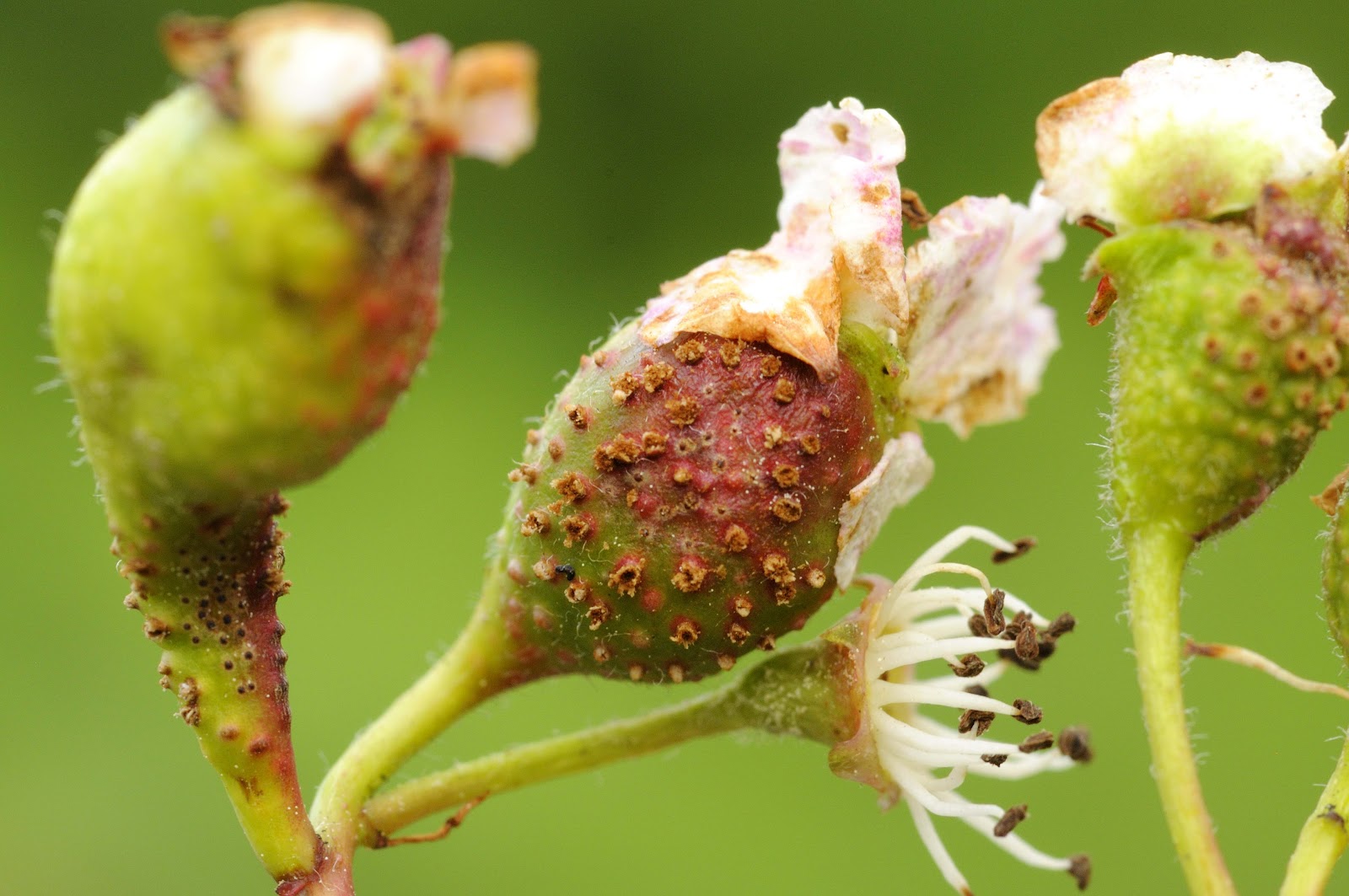
fungus appearing on a juniper bush in our garden and on juniper bushes in Tulloch there would be a possibility of looking for the secondary growths, known as the “aecia” stage, because at both sites hawthorn bushes were present. Well, well. At Tulloch red marks started to appear on the hawthorn leaves in late May and as the flowers changed to berries in early June strange cup-like structures (right) started to appear, covering most of the berries and some of the leaves. A check of the ornamental hawthorn in our garden also had growths and when I checked the internet for photos it was obvious that these cups were the secondary phase of the Gymnosporangium fungus, the cup-like structures being the source of spores which would infect juniper bushes again next year. Amazing. As I was photographing hawthorn berries, Ian, one of the Osprey Centre summer staff stopped to say that he had found a large red-belted clearwing moth (Synanthedon culiciformis) on Tulloch Moor at the start of June, the first record on the reserve since Dr. Harper’s find in 1974! Well done Ian. I have yet to see one despite several searches so to see what this amazing moth looks like go to http://ukmoths.org.uk/show.php?bf=381 .

The elm wood mentioned in last months diary continued to impress and on the way back from visiting my BTO BBS square nearby, I called in to try and re-find a rust I had found on a wood anemone leaf (each to

his own!). On the way to the location a distant couple of “big plants” caught my eye and as I approached them I knew I was looking at a member of the buttercup family (left) but with flowers yet to open. I took a photo so that I could confirm once back home that I had found a couple of globeflowers. Janet confirmed that my initial ID was correct and when I checked NBN to see how many local records were known I found the nearest site was at my previously visited site of Huntly’s Cave (http://data.nbn.org.uk/interactive/map.jsp?srchSp=NBNSYS0000002692 ), a good excuse for another visit to see if they were still there. After a morning putting the finishing touches to a talk for the Boat Village Hall series at the end of June, I headed off to stretch my legs and descended once again into the gulley below the climbing rock at Huntly’s Cave and, with lady luck on my side, found a couple of plants right away. Searching around for more I found masses of beech fern, red campion, a small amount of herb bennet growing with shining cranesbill and climbing corydalis. Below the steep path by the climbing rock was perhaps the original record site for the NBN globeflower record with 10 flowering spikes and just as I was taking their photo a couple of tourists appeared from the path enquiring if I knew where they could find “Huntly’s Cave”. Sadly I

couldn’t help them because despite my searches I hadn’t seen anything that looked like a true cave. Crossing the burn and heading up the slope on the opposite side to the rock I came across mountain melick grass along with something I hadn’t seen in a long while, a rather sad looking reptile, a slow worm. This legless lizard looked like it had been attacked by something and had scarring all along its body and a rather painful looking hole, with exposed bone, at its tail. Sensing my presence it slowly slithered away to hide under one of the many rocks where I left it in peace. As I clambered about amongst the rock gullies I came upon something that might have had a link to the damaged slow worm, a latrine which would have had to belong to a pine marten or a wild cat due to its location. Perhaps mammal and reptile had met or perhaps the mammal had young nearby and one of them that had been “playing” with the slow worm, inflicting the damage. The gully was loosing its botanical richness as I headed north above the burn so it was time to tackle the climb back up to the car after another interesting outing.

11th June, 12.54pm. With such precise timing it had to be Olympic torch day and the venue was Grantown on Spey. I went early just to select a good spot for a photo and an hour ahead of the start time, the torch bearers were sitting on the “Moment to Shine” bus receiving their instructions. Having walked all the way up the High Street it seemed to me that the best spot was near where the whole jamboree would start and as the time approached more and more police on motorbikes arrived, assembled, and set off in the direction the torch relay would go. Posh BMW’s passed by all with corporate livery followed by the Samsung open-topped bus with music and rah-rah folk up top telling everyone the torch would be along shortly. Next was the Coca-Cola wagon with

free drinks being handed out to all and sundry. Then the torch but it was late, and didn’t start its passage until 12.56, no doubt someone would be in for a rollicking! With bus and relay passengers at the front, more vehicles behind, police out-runners and police on push-bikes it really was quite difficult to know exactly where the torch carrier was, and in the blink of an eye torch bearer 038, Sam Macphee from Burghead was past and up the road towards the huge numbers of folk on the main part of the High Street. Time for a swift exit, up a couple of linking side roads, arriving just in time to see the whole cavalcade reach the end of its U-shaped tour through Grantown with torch bearer 040 (039 did the middle bit of the town) Abi O’Grady from Morayshire running the final section. As with all the torch bearers there are stories to tell – here is Abi’s http://www.london2012.com/torch-
relay/torchbearers/torchbearers=abigail-o-grady-1785/ . Within what seemed to
be a few minutes the cavalcade had disappeared and was off to meet a new deadline of 13.32 at Tomintoul. What a pity we couldn’t have seen the torch being carried along the high road over the tops to Bridge of Brown, sadly not possible by 13.32. A few days later another relay team passed through Grantown, a team that was running the whole torch route on foot in the real Olympic spirit. Sadly few folk were there to greet them at 01.32 in the morning!

The last visit was made to the farm wader count site on 21st to try to get as accurate a count of breeding success across the site, no mean task with grass growth pretty amazing with all the wet weather. It is nice to report that several families were seen with 1-2 redshank broods, 2-3 oystercatcher broods and possibly as many as 5 lapwing broods. What isn’t so good is that this is the total success over several hundred acres and that all the broods were found in just 3 fields. The wet weather has been a real saviour to these birds meaning that wet areas from April remained wet and remained unmanaged

throughout due to mainly standing water (right). Not too sure how the juvenile birds have coped with the ongoing deluges since the count, but fingers crossed a few made it to flying stage. This has to be one of the most depressing surveys to undertake when an area of this size should be producing dozens of wader chicks and here I am saying that it was nice to report probably a maximum of 10 families. Our “green and pleasant land” is certainly very green, but not very pleasant for any form of wildlife anymore.

June has also been flower counting month, though the count of the brilliant lesser butterfly orchid (LBO) field had been delayed until first week of July to allow the flowers to open, they having been badly held back due to cool, wet weather. Several years ago I recorded LBO’s near Whitewell on Rothiemurchus Estate and
was asked to see if they were still there. The day before I visited a pressed grass fell out of my flower book (as it does regularly!) and telling myself how lazy I had been not to have checked it out since collecting it on the Isle of Lewis in 2010, I did a dissection. Combining microscope and the book ‘Grasses of the British Isles’ arrived at the name marsh foxtail (Alopecurus geniculatus). Next day, under leadened skies, I headed off to Rothiemurchus in search of LBO’s. I parked the car and had a wander round in sodden grass and found a few small white orchids (left) which are also known to be at the site. So, I was distracted as usual quite early into my visit, and started to search the wider area around the small whites just in case there could be a few LBO’s hiding there. There wasn’t, but there were more small whites. Eventually I arrived in the general area where I had previously seen the LBO’s, even remembering a few of the features from my earlier visit, but despite a wide-ranging search, none could be found. However, more and more small whites were found so
my objective changed and I spent a couple of hours wandering back and forth searching all suitable sites. At one stage I ended up on a badly rutted and water-filled track where a grass suddenly looked very familiar and for the second day in a row I was looking at marsh foxtail (right), this time in full flowering glory – well it looked good to me! Once home I totted up all my GPS locations for small white orchids and was amazed when the total came out at 89 flowering spikes, perhaps one of the better counts for this site. I finished the day doing something I hadn’t done since I was living in Lancashire some 39 years ago – visit Lewy’s barbers shop in Aviemore to try out a hair and beard trim in preparation for a very special day in a couple of weeks time.


That's it for another month
Enjoy the read
Stewart & Janet


Bikeathon Kingussie for Leukaemia Research


Honey bee visiting broom


Large red damselfly

All photos © Stewart Taylor

Sunday, 24 June 2012

A tale of two cowslips and another pine marten encounter

The changeable weather of late April delayed my visits to the BTO breeding bird recording squares and with good weather forecast for the first few days of May it was up early on the 1st. and a peep out of the curtains showed a bright if misty sky. As I travelled towards Grantown on Spey it was headlights on as I started to encounter mist and by the time I was heading down the back road to Cromdale I was beginning to wish I
had stayed in bed! I got to the car parking place and despite the mist the birds were singing and with most of the survey relying on hearing birds, off I went. This survey is based on walking out along one side of a one kilometre map square, counting whilst you walk across country to the other edge of the map square and then heading back towards your starting point. The first forestry section was completed in the mist but on the return leg along a road with farmland either side the mist had lifted and it was possible to see some birds as well as hear them. Nothing too unusual was recorded, but 28 species were seen or heard, the commonest being chaffinch (24 contacts), wood pigeon (17) and willow warbler (13). By the time I returned to the car there were bits of blue sky appearing, so much so that later in the day it was sunny enough to walk the butterfly transect. The next day it was up again early to do the second breeding bird square, the one that goes over the steep hill with the two cairns and a telephone mast on top. All looked well until I got to the base of the hill when once

again the mist rolled in, but, being a hill, I thought the mist would clear as I climbed. Wrong! However, the route is simple enough so there was no problem in undertaking the double crossing of the hill top. Muir burn (heather burning) had been undertaken over a good part of half of the return leg, taking in huge swathes of hillside rather than the recommended regular thin strips ensuring this part of the survey area will remain very definitely in the MAMBA category for birds, including red grouse, for the next few years. Sorry, MAMBA is shorthand for “miles and miles of B all”. It really is appalling what we are allowed to do to our countryside in the name of sport. One benefit of the removal of heather by burning was the un-earthing of an unusual spiky moss (above right) called large white moss (Leucobryum glausum).  With a bit of woodland in the square 19 species were recorded the commonest being a flock of common crossbills (10) and meadow pipit (7), though a pair of golden plover was nice.

Not to be caught out for a third day I stayed in bed on the next morning when really I needed to be up and about to carryout the local farm wader survey. This survey relies heavily on visuals rather than sounds and with another misty start the survey would have been impossible. So after popping in to vote (local council

elections) and with the sun shining, it was off to Delnabo near Tomintoul for a walk, calling in at The Gallery in the village to drop off some of Janet’s tweed crafts on the way through. As we walked I made a list of the birds seen and heard for the BTO Bird Track programme and it was nice to see my first blaeberry bumblebee (Bombus monticola) of the year and hear my first cuckoo. The weather forecast for the next few days was looking pretty poor again so in the evening I headed out to do the first of four visits to my regular farm wader survey area, postponed from earlier in the day. The only problem with doing the survey in the evening, which is allowed, is that there is a very definite deadline – the time it gets too dark to see, whereas carrying it out at dawn there are no such problems if you encounter a few delays along the way. Another problem is that if the weather is good there is every chance that the farmers might be still working, as was the case. At one end of the survey area lime was being spread and at the other a recently sown field was being rolled. Having surveyed this field an hour earlier (the survey takes about 3 hours) I knew there were three sitting lapwings and one oystercatcher and though the farmer made every effort to avoid the nests by lifting the eggs, rolling and then putting the eggs back, it was a while before the birds felt happy enough to return to their incubation duties by which time some nests were lost to marauding common gulls. Also, with the weather having changed for the worst at the end of March, many fields had still to be harrowed and sown, a few still to be ploughed, so lots of upheaval to come for birds trying to breed. As it was getting almost too

dark to see I was heading back towards my starting point via a nice piece of birch woodland when I remembered to look out for a small group of cowslips by the track, and sure enough, there they were as found originally in 2005 and again in 2010 during earlier wader surveys. There was just time for a photo(above left), despite the darkness, before pushing on to complete the survey. The next day it snowed! The day after that remained very cold and all the swallows, sand martins and house martins from miles around seemed to converge on the River Spey by Broomhill Bridge to try and find any insects that were hardy enough to be on the wing. Thankfully the weather warmed up a bit on the Sunday for the Nethy Spring Gathering, where Janet had a craft stall for the day (white tent right), the splash of sun tempting good numbers of folk out to visit the stalls and to enjoy the entertainment.

For over a year ex workmate Andy had been extolling the virtues of a patch of ancient mixed broadleaved woodland near Grantown, and he repeated this when I queried the identification of a plant I had found on

my visit to Huntly’s Cave. The plant I was having trouble with was a golden saxifrage, was it opposite leaved or alternate leaved, and to help with my query he suggested I visit the ancient woodland site where I would find both species growing side by side, so, with the perfect excuse, off I went. The first good plant I encountered was moschatel growing next to a group of the first leaves of figwort. Next, the birch trees gave way to aspens, big, ancient aspens along with old willows and enormous elms. In between were hazel bushes many of which were dripping with lungwort lichen (Lobaria pulmonaria), a rare feature in this part of the Highlands and more akin to woodland around Loch Ness and further west. Big elms like these have the potential to be home to the rare RDB lichen I had found on a rock face a couple of months ago Gyalecta ulmi, and before the UK elm population was devastated by Dutch elm disease, elm trees were the main habitat

for the lichen. There were quite a lot of elms to check in this wood, so this would require a dedicated visit at a future date, but there on the track below the first of the elms was opposite-leaved golden saxifrage (above left) and a little further down the slope its close but rarer relative alternate-leaved golden saxifrage (right), quite different once seen. What a wood, ancient, and on this first brief visit, as good as anything I had seen locally for lungwort lichens, but what would the Gyalecta ulmi lichen look like on a tree rather than on a rock face? A return visit would have to be made to the amazing wood at Inverfarigaig, the only site in the North of Scotland where the lichen has been recorded growing on an elm tree.

So, the next day it was off up the A9, along the minor road past the RSPB Reserve at Loch Ruthven and on to Inverfarigaig just in time for the rain to start falling. So it was on with the waterproofs before I made my way up the hill to the ancient wych elm where

the rare lichen was known to occur, and sure enough, there it was (left), growing over several square centimetres of the tree bark. The only difference between the lichen here and at my rocky site was the lichen on the tree had lost the “apricot jam” centres to the disc-shaped apothecia, probably due to the attention of slugs and snails. As I checked the trunk a little higher up there were a few more bits of the lichen but most unusual was finding a snail hanging down from a section of bark, most unexpected. Mollusc expert Richard identified the snail as Clausilia bidentata (below right), a reasonably common species but a new record for this particular location. Back down on the minor road I spotted something bright red growing on a dead spruce branch and on closer inspection it turned out to be the scarlet elf cup fungus (Sarcosypha austriaca). Another unusual lichen was also known to grow on another elm nearby and the clue to the correct tree was that when the
lichen was last photographed there was an old bird nest box at the base of the tree, so the search was on, but first find the nest box. I was less than confident of finding the latter, so much so that I travelled light and left my rucksack and camera behind to allow for easier clambering over jumbles of rocks. Eventually I reached the base of the main crag and was pleasantly surprised to find good patches of flowering shining cranebill (below left), and close by clumps of climbing corydalis, both rare plants on my home patch. There were just a few elms along the base of the crag and eventually
in a wee hollow I found my fallen nestbox and in the hollowed out base of the adjacent tree, there was the Bacidia incompta lichen. Now where was that camera! The trip back down and up the hill though did have a useful ending – finding Peltigera britannica a lichen missing from the earlier survey. Armed with this “elm lichen” information I was ready for a return to my Grantown wood.

Mid-month and it was time for the second recording visit for the farm wader survey and with a -2.5 degree frost overnight, conditions were clear but cool. As I parked up at 5.45am and headed out across the first field I was aware of the sound of a helicopter close-by overhead and as I reach the high-point of the field, a good vantage point to scan several of the fields ahead, I could see a whole host of flashing lights in the distance on the A95 road, and just at that moment the wee yellow air ambulance dropped into view and landed on the road by vehicles and their flashing lights. Even from a long distance I could see that there had
been a head-on collision between a car and a delivery van, the van stopped at an angle on the road but the car, minus its roof which had been removed to gain access to its passengers, up on the grass verge. The road approaching the crash was full of lorries, some of which had decided the road would be closed for some time, and were in the process of finding places to turn around. As I got back to my starting point three hours later, the A95 had been closed and the traffic was now zooming by on the B970; it looked like accident investigators were
now at the scene. It had been a ‘not too bad’ wader morning, there were 3 lapwings sitting on re-lays in the ploughed/rolled field, a pair with very young chicks, a pair of oystercatchers looking like they would nest in a field that had yet to be sown (fingers crossed) and redshanks were alarmed enough at my presence in two locations to indicate they had intact nests nearby. In the wee birch wood the cowslips were still flowering and in one of the last fields to be checked there was a sea of flowering dandelions. Amazingly, the van driver and the two passengers in the car all survived the crash but the road remained closed for over 12 hours. Back home it was time to start sorting out photos for a talk in the Boat of Garten village hall at the end of June along with a quick snooze for and hour before heading up the road to the Black Isle to meet up with Dave (SNH) and Giles (FCS) to see a new site for the green shield-moss. Some day!

The sun came out for long enough on the 20th to allow another of the weekly butterfly transects near Loch

Garten to be completed, though only green-veined whites and orange tips (female right) were seen. Insects in general have just not had the chance to get going this month with the cooler weather predominating. On the edge of Tulloch Moor a wee ground bug by the name of the pine cone bug (Gastrodes grossipes left) was found, though it took a little help from Stephen at the HBRG to get exactly the right name. This was a first for Abernethy NNR. In the afternoon I made a return visit to the
Grantown wood and a start was made to check the elms and all the aspens and willows in between, a job that was going to take several days of searching. Sadly I was unable to find either of the rare elm lichens seen at Inverfarigaig though many had good populations of lungwort along with other lichens that an expert might be able identify. On a couple of rock outcrops the very local grass mountain melick (Melica untans right) was found
plus a couple of jackdaw nest in deep holes in amongst the rocks. Find of that week though was common twayblade in three places close to the River Spey at Spey Bridge, the two big basal leaves being the giveaway and with tiny flowering stems just starting to appear from between them. Then a miracle happened and the sun came out for a couple of days which pushed the temperature to 30 degrees C before breaking down with torrential downpours. It looked like our trip to Lancashire to see Janet’s mum the next day could be fun, particularly on the motorways.

The next day we were up bright and early as we packed and got ready for an
early-ish start to our journey south. I was in the process of packing up my rucksack when Janet shouted from upstairs “the pine marten is in the squirrel feeder”, meaning drop everything, grab camera and telephoto lens, and dash upstairs to see if I could manage a photo before it disappeared. As I got to the upstairs window with camera and lens just about assembled, Janet said it was off and I was too late, annoying really, ‘cos the camera was now ready! “It’s going up the nest box tree” and sure enough, in a flash, the marten was at the box (the tall one in the garden with 3 holes) poking its head right into the slightly enlarged, bottom hole! By this time the resident starlings, with their young in the middle hole, were going bananas, but the marten continued to try to get into the bottom section of the box. The starlings screaming attracted several jackdaws which in turn attacked the marten, which, after yet another attempt to get into
the bottom hole, decided it was time for a swift exit, and off it went through the trees. In all the mayhem we were fairly certain that one of the young starlings had made a bolt for it, taking its chance at an early attempt to fly rather than fall prey to the marten. Eventually everything calmed down and within 15 minutes the starlings were once again bringing in food to their brood. So, a little later than planned, we headed south with window-wipers on until Glasgow, arriving in Lancashire to a sunny evening. Several days of socialising followed with trips out to various eating venues in the Ribble Valley. On a free evening we headed out to an old quarry site at Clitheroe, once part of the massive Ribble Cement limestone quarrying empire, to see what was flowering and in the hope that we might have seen an early orchid or two – particularly bee orchid. We weren’t that lucky but did see lots of cowslips, water avens (left), a single
spring cinquefoil and flowering guelder rose, to name a few. Then, after a few days in the company of an amazing nonagenarian, it was back up the road in time to greet our next chalet guests.

That’s it for another month; blame the plants, birds etc for lateness.

Enjoy the read.

Stewart and Janet


The amazing nonagenarian – Janet’s mum


Lesser swallow prominent moth


The famous Pendle Hill - witch country

All photos © Stewart Taylor